

 Small World, Big Future
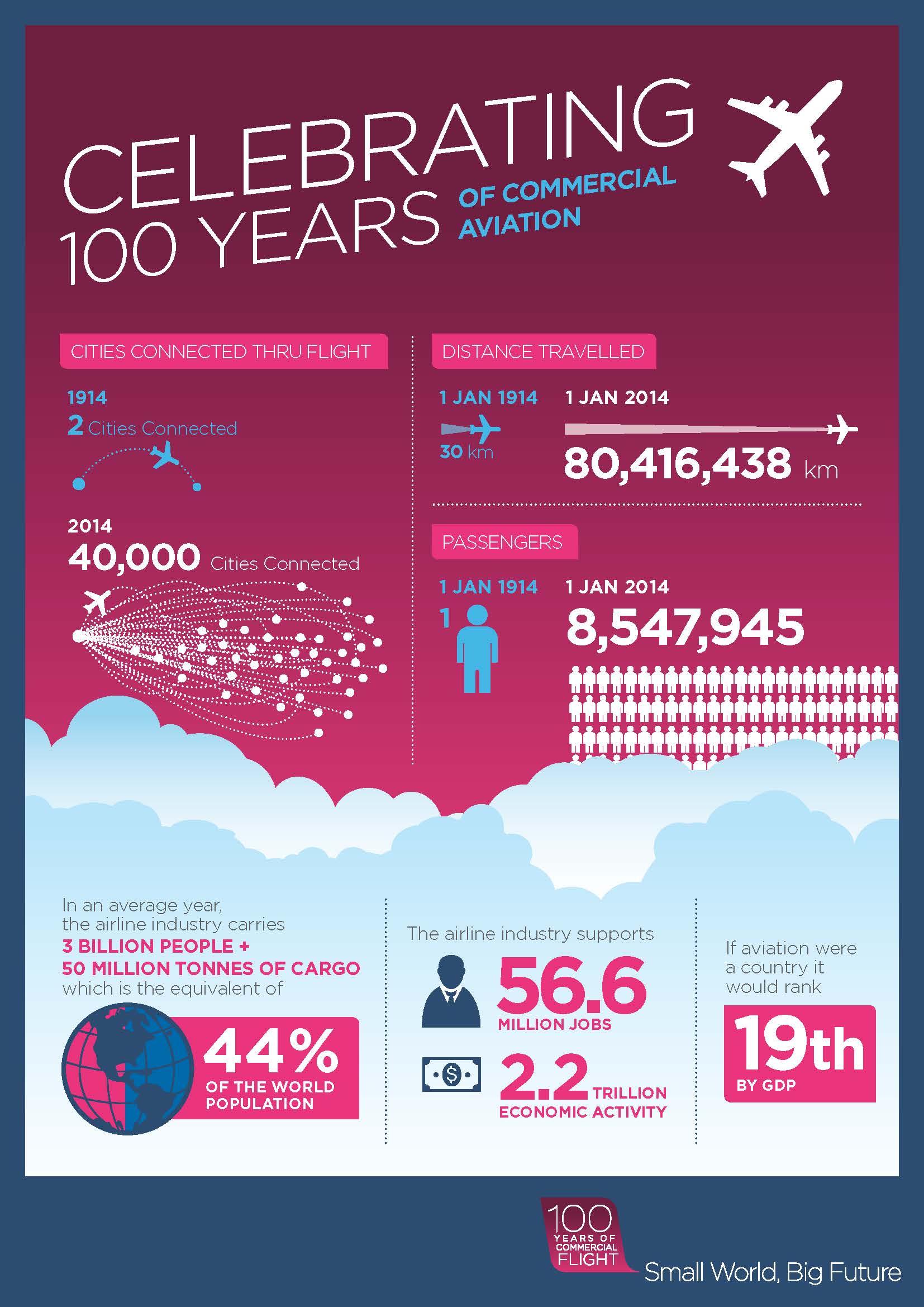
2014 was a special year in the history of aviation. 1st January marked exactly 100 years since the first scheduled commercial air passenger flight, across Tampa Bay in Florida, USA.
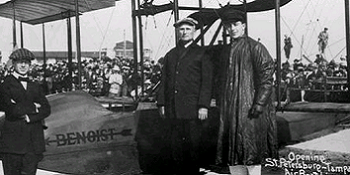
In 1914, an entrepreneur named Percival Fansler saw the opportunity for a regular air service across the bay. He knew it would significantly cut the travel time between the two cities of Tampa and St. Petersburg. He and his investors commissioned two flying boats from the manufacturer Thomas Benoist, along with a famous pilot, Tony Jannus, to fly them.
The first ticket for what would become an historic trip across the Bay was sold at auction to a local businessman, Abram Pheil, who purchased his place in history for $400 (equivalent to nearly $10,000 today).
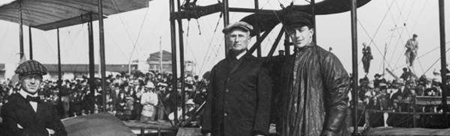
In a stirring speech at the launch, Fansler predicted, “The airboat line to Tampa will be only a forerunner of great activity along these lines in the near future….what was impossible yesterday is an accomplishment of today – while tomorrow heralds the unbelievable.”
And he was right! We've come a long way in 100 years...
To celebrate the 100th anniversary of this historic event, IATA worked alongside airline and airport partners to promote how aviation has grown from this humble beginning to be an integral part of people’s everyday lives. Here, we've compiled a snapshot of some of our favorite stories and moments from our 'Flying 100' archive.
How it all started - The story of the world's first airline
This account is adapted from The Making of St. Petersburg by Will Michaels, Published by the History Press, 2012.
Each year, the Tony Jannus Distinguished Aviation Society celebrates the world’s first airline and its record-breaking pilot, Tony Jannus. And where was this airline? New York? Chicago? London? Berlin?
No. The world’s first airline originated in St. Petersburg, Florida.
The world’s first regularly scheduled heavier-than-air airline took off from the Municipal Pier in St. Petersburg on New Year’s Day 1914. The airline was known as the St. Petersburg–Tampa Airboat Line. It was organized just a few months before that New Year’s first takeoff. The airline was the brainchild of Percival E. Fansler, a Jacksonville-based electrical engineer. Fansler enlisted the support of Thomas Benoist (pronounced ben-wah), an early airplane manufacturer who provided the planes-or, more precisely, the airboats. The airboat was known as Benoist Airboat Model XIV, no. 43. The model number referred to the year in which the plane was to be offered for sale (1914). The number indicated that it was the forty-third aircraft to be built from initiation of the Benoist Aeroplane Company.
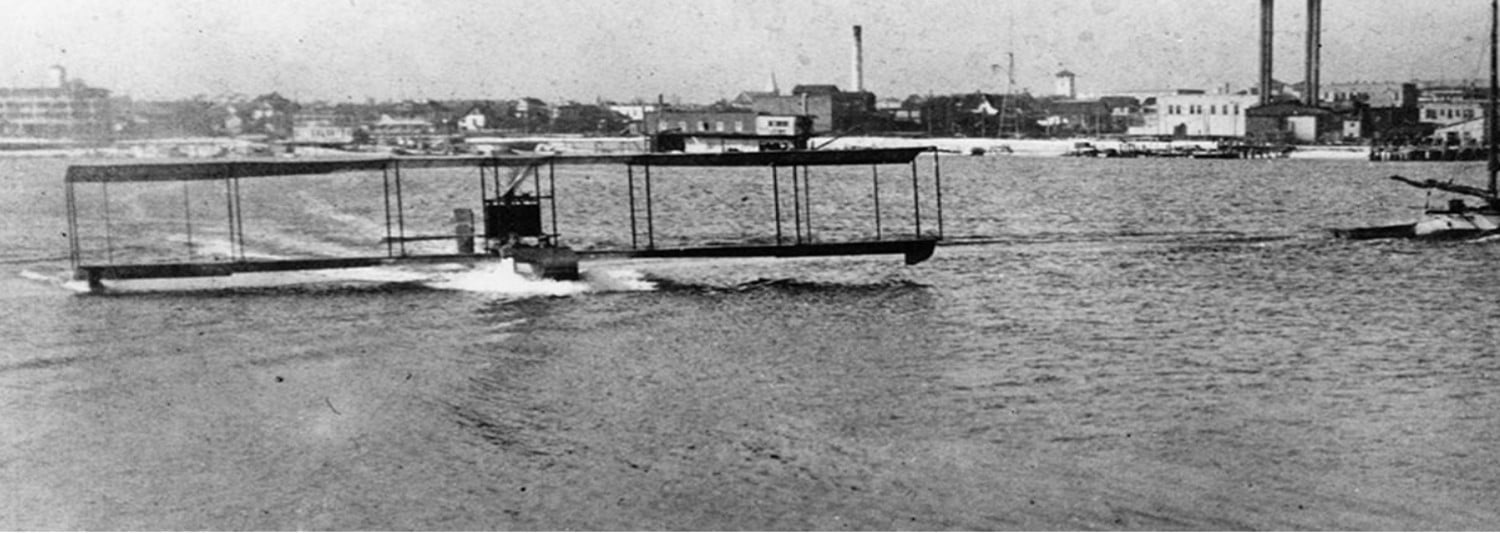
The Benoist Airboat was an early version of what we now know as a seaplane, able to take off and land on water. This was a necessity at the time as St. Petersburg had plenty of water but no airports. Airboat no. 43 was supplemented a little later by a second airboat, no. 45. The two airboats made up the airline’s total fleet. No. 43 accommodated one passenger in addition to the pilot. No. 45 was somewhat larger and capable of accommodating two. Benoist also provided the pilot, Antony Habersack Jannus. Tony Jannus was a test pilot for Benoist who set early records for passenger flight time and for overwater flight in 1913, and he was the pilot when Albert Berry made the first successful parachute jump. He also held the first federal airline license.
But this world first would never have been possible without the backing of Board of Trade manager L.A. Whitney and businessman and later city mayor Noel Mitchell. In order to make his plan for a new airline work, Fansler needed the support of the St. Petersburg business community and the city’s government. He also needed a subsidy to help reduce the financial risk to Tom Benoist. Fansler made his proposal to Whitney, who immediately pledged $1,200 to subsidize the airline. Whitney then referred Fansler to Mitchell, who pledged another $1,000. Mitchell then gathered eleven other local investors to pledge $100 each to start the airline. Mitchell even got the city to build a hangar for the airboat on the South Mole of the municipal pier, at the foot of Second Avenue Northeast.
“What was impossible yesterday is an accomplishment of today - while tomorrow heralds the unbelievable.”
“Tony Jannus Will Make First Flight Thursday,” read the headline of the St. Petersburg Daily Times on December 30, 1913. On January 1, three thousand people gathered to see the first flight of this fledgling airline. This was a huge crowd for the city considering that the permanent population was perhaps seven thousand people at the time. Among the crowd was the humorist Will Rogers, who was performing at the Johnny Jones Circus in St. Petersburg. In a charity auction to raffle off the first flight ticket, former St. Petersburg mayor Abe Pheil bid $400 for the privilege of being the first passenger. Invited to say a few words just prior to takeoff, Percy Fansler commented, “The Airboat Line to Tampa will be only a forerunner of great activity along these lines in the near future…what was impossible yesterday is an accomplishment of today-while tomorrow heralds the unbelievable.”
Jannus then took off, skimming across the bay at a height of fifty feet. After a twenty-three minute flight, including a brief landing on the bay to make adjustments to the propeller drive chain, Jannus and his single passenger, Ave Pheil, touched down on the Hillsborough River in Tampa. An even larger crowd of 3,500 greeted the Benoist in Tampa. Tampa mayor Donald B. McKay welcomed Jannus and Pheil. The return trip took only twenty minutes.
Upon arrival back in St. Petersburg, Jannus dropped his flight goggles, breaking the glass. Ten-year-old Judy Bryan ducked under the rope holding back the crowd. Running up to Jannus, she asked if she could have the goggles. Without hesitation, he gave them to her. Then he removed one of the brightly lettered Benoist pennants from the wing and handed that to her also.
In the weeks that followed, Jannus made at least two regularly scheduled round trips a day between St. Petersburg and Tampa, carrying everything from Swift hams to bundles of the St. Petersburg Daily Times (now the Tampa Bay Times). Cost of a passenger ticket was $5 each way and $5 for each one hundred pounds of freight. This was not cheap, as $5 in 1914, adjusted for inflation, is valued at $115 in 2012. While $5 per trip was high compared with the cost of rail or steamship, it barely covered the costs of operations. When Tom Benoist was asked how he could cover his costs and make a profit, he stated, “There are at present about 30,000 tourists in the area and I believe a great many of them will patronize the airboat line to save time. Besides, I am anxious to demonstrate the capability and practicality of aerial transportation at a price anyone can afford even if such a low rate means a revenue loss to me, for today’s loss could very well be tomorrow’s profit.”
Jannus lauded his time in the Tampa Bay area. In April 1914, he wrote in Aero and Hydro magazine, “All told we believe that our work has stamped St. Petersburg as the aviation headquarters of Florida and this is largely due to the hearty cooperation of the city and citizens of the town. There are now hangars that will hold four large [flying] machines and plenty of room to put more and I must say that Tampa Bay is a fine place to fly in winter.”
Finally, as the tourist season wore down, the airline suspended its daily operations on March 31. The airline continued for another month with a reduced schedule and flights upon request. The last flight was on May 5. The airline did not break even but came close to it. It appears to have been self-sustaining in two of its three months of operation. In January, it only flew eighteen days. The amount of subsidy drawn from the business community ranged between $540 and $1,740. The exact financial net of its operations is unclear. Given more time for marketing and optimizing operational efficiency, the airline may very well have turned a profit.
The Benoist no. 43, also known as the Lark of Duluth, was actually owned by banker Julius Barnes of Duluth, Minnesota. He had either loaned it or sold it back to the Benoist Company for use in the St. Petersburg–Tampa Airboat Line. According to aviation historian Warren Brown, after the airline closed, no. 45 was sold to Roger Jannus. Roger Jannus then sold the airboat, and it was taken to San Diego, where it crashed in the ocean in February 1915. Several local aviation enthusiasts bought Benoist Airboat no. 43 and took it to Conneaut Lake, Pennsylvania. The plane crashed but was rebuilt and named the Florida. The Florida was brought back to St. Petersburg, and Tony Jannus returned to fly it. On February 25, 1915, the flying boat crashed in the bay after a wing broke. It was again rebuilt. In November 1916, no. 43 was placed in storage, and after that was lost to history.
Tony Jannus was killed in World War I in an accident while training Russian pilots over the Black Sea for the Curtiss Aeroplane Company. His brother, Roger Jannus, enlisted in the Aviation Branch of the United States Signal Corps during World War I and was killed in 1918 at Issoudon, France, when his de Havilland-4 burst into flames in midair. (The de Havilland was known as the “Flying Coffin.”) In referring to Tony Jannus, R.E.G. Davies, curator of air transport at the Smithsonian Institution National Air and Space Museum, said it best, “Of all the early aviators, his career and achievements were possibly the most influential before the outbreak of the First World War. Had Jannus lived, Charles Lindberg would have had a worthy rival.”
Jannus’ achievements and the significance of the world’s first airline have long been recognized. In 1964, the St. Petersburg and Tampa Chambers of Commerce established the Tony Jannus Distinguished Aviation Society to annually honor Jannus and the first airline. The Jannus Society’s annual award is known as civil aviation’s premier recognition for extraordinary accomplishment. Past recipients include such aviation icons as Donald Douglas, Captain Eddie Rickenbacker, Lieutenant General James H. Doolittle, Frank Borman, Charles Yeager, Sir Freddie Laker and Norman Mineta. Portraits of Jannus and the first airline painted by 1930s Works Progress Administration muralist George Snow Hill hang at Tampa International Airport. Jannus was also inducted into the Florida Aviation Hall of Fame.
A new wing was built at the St. Petersburg Museum of History in 1992, dedicated to a permanent exhibit featuring the first airline and its founders. This includes a flying reproduction of the Benoist no. 43. The goggles and pennant given by Tony Jannus to ten-year-old Judy Bryan, along with a full-size working replica of the Benoist Airboat and other memorabilia relating to the first flight, are on permanent exhibit. Another replica hangs at the St. Petersburg–Clearwater International Airport. In 2006, Tony Jannus’ portrait was added to the First Flight Shrine at the Wright Brothers National Memorial in Kitty Hawk, North Carolina. He was designated “A Great Floridian” by the State of Florida in 2010. Downtown St. Petersburg's Jannus Landing entertainment center is named after the famed pilot.
In 2010, the American Institute of Aeronautics and Astronautics (AIAA) designated the Central Yacht Basin in St. Petersburg as a Historic Aerospace Site-the place of the first commercial airline flight. In 2011, astronaut Nicole Stott carried the original Benoist pennant on the thirty-ninth and final flight of space shuttle Discovery (STS-133). In 2012, efforts were underway to plan the celebration of the centennial of the first airline in 2014, including petitioning of the U.S. Postal Service for the issuing of a Centennial/Jannus commemorative stamp.
The contributions of Percy Fansler and Thomas Benoist have been overshadowed by Tony Jannus over the years. While Jannus was the chief pilot of the St. Petersburg–Tampa Airboat Line and effectively served as its public face, the company could not have accomplished what it did without Fansler and Benoist. The idea of the airline was Fansler’s. It was he who enlisted the sponsorship of the Benoist Company, sold the project to the St. Petersburg business community and city government and served as airline manager. Tom Benoist provided the planes and chief pilot Tony Jannus and agreed to operate the airline on a break-even basis. Percival E. Fansler and Tony Jannus were inducted into the Florida Aviation Hall of Fame in 2003. Thomas Benoist was inducted in 2012.
“Someday people will be crossing oceans on airliners like they do on steamships today.”
This is a story of both a Florida and world "first." But it is also the story of a future-oriented community that appreciated the latest in invention and was willing to take a risk to see whether the concept of an airline could be of practical value to a booming Florida area - and further add to that boom. While the airline did not quite make a profit, it paid other dividends. Commenting on the significance of the airline, Tom Benoist, the builder of the Benoist airboat said, "Someday people will be crossing oceans on airliners like they do on steamships today."
The airline served as a prototype for the future. Others would build upon the St. Petersburg-Tampa Airboat Line’s experience to create the multi-billion dollar aviation business that the world enjoys today
“To me, flying is not the successful defying of death but the indulgence in the poetry of mechanical motion, a dustless, relatively bump-less, fascinating sensation of speed; and abstraction from things material into an infinite space; and abandon that is more exciting but less irritating than any other form of mechanical propulsion…Florida is a live, wide-awake place for aviators and St. Petersburg is the best town for that purpose…”Tony Jannus, 1914.
Flight 2014 reenactment
Watch Flight 2014 recreate the first commercial flight in St. Petersburg, Florida, including interviews with Ed Hoffman, Kermit Weeks and Will Michaels. The event celebrating 100 years of commercial flight was organized by Flight 2014; the International Air Transport Association was a sponsor.
Click on each title to reveal its story
How travel inspired my cooking
Yuko Kobayashi is the chef-owner of Kitchen 5, a popular restaurant in the heart of Tokyo, Japan.
I have always enjoyed international travel. It is a habit that I have had since even before I began running my restaurant in Tokyo for over three decades ago. My personal interest was to follow the “Spice Road”. So I have focused on the Mediterranean and covered most of the Latin Countries—from the Levant through to Southern France and Spain.
Long ago I decided that in principle I would take two long vacations each year—a month in the winter and five weeks in the summer. The central objective of the travel was the pursuit of a personal theme—food!
When I travel, I get up early in the morning to go to the local market. If I was in Spain, I would pretend to be a Spaniard as I stand before the market stalls and think about what I might buy and what I might make with it. And as I was doing that, I would expand my thoughts to the foods of neighboring countries—France or Portugal-which I am also familiar with. Gradually a menu would formulate in my head. And I would often be surprised at how quickly time passes while in these thoughts. When I would go to a restaurant, I always would think about each dish as I was eating. If I had cooked it, would I have done it the same way? What ingredients would I have used?

Recently, I have tried to include in my travels opportunities to spend a few weeks of each trip working in restaurants, in an auberge or in the house of a food expert. Even more important than studying the cooking methods is seeing how ingredients are handled and used. It is quite different from how you would do in Japan. Over time, some stereotypes were overturned and the feeling of distance would narrow.
When I started my restaurant some 30 years ago, I wanted to serve food that had not been introduced in Japan. At that time, my place was probably the only one in Japan serving couscous. Many people asked if I was changing the taste to meet the Japanese palate. Absolutely not! I was not even thinking of that. When people travel to exotic places overseas they have an opportunity to try delicious local foods. Delicious food is delicious even if it is not the flavors that you are used to. So when I cook, I want to make what I remembered as tasting delicious.
In globalized food world of today, that is important because we are losing some of the color and character of individual countries or regions. My aim is to make food that only I can make. When I return to Japan I try to make food for my customers that was inspired by my travels.
I also believe that it is really important to cherish regional cuisines that have been passed down through generations. It’s special because you can only eat that dish in that specific part of that specific country. Preparation is often time-consuming but there is something special in cooking and preserved food styles that have been made in the same way in the same climate for years.
I found one example in Sicily. About 20 years ago I traveled there looking for tomato paste made from sun-dried tomatoes. “That stuff! Who still makes it?” I was questioned. Some restaurants still make the effort, but in homes it was pretty much obsolete. There is no substitute for the unique taste, and it is essential for Sicilian cuisine. I found another example in France when I traveled to a village called Meyssac, which is about an hour by car from Brive where the nearest train station was. I traveled there to study cooking from a teacher who was 100 years old. It was winter and it was cold with deep snow. They used fireplaces for warmth and for cooking. And she taught me how to make a famous dish which was called Farcidure. We put salt pork in a pot hanging over the fire. As the pork boiled, we started to make some bread dough. The soup was ready about the time that the dough had risen. After that we removed the pork and dropped the dough into the pot to boil for an hour. And then we had a great rustic meal of bread, boiled pork and mustard.
The bread is known as La Mique. But most of the French guests at my restaurant had never heard of it. And even among those that did, not many had ever experienced it because it is so complicated and time consuming to make. Having made the trip to Meyssac, Farcidure is still an important part of the repertoire of food that I prepare for my guests.
One day a Frenchman came to my shop and was very surprised. “What is this Farcidure?” he exclaimed in a loud voice. I responded that I had learned to make it in Brive. “I am from Brive. Do you eat this?” he asked. “Of course,” I answered back. That was a very happy memory for me. In fact, it was one of those times when you have a lot of self-satisfaction and you really think “that was great.” I realized at that moment that I would have to continue to make Farcidure. And the experience also reminded me what a precious thing international travel is.
Interview with Astronaut Roberta Bondar
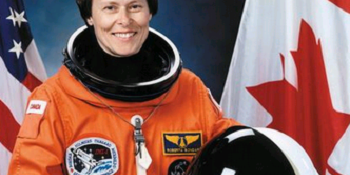
Roberta L Bondar O.C. O.Ont. MD PhD FRCP FRSC ICD.D
My grandmother flew in an airplane before my feet had left the ground for more than a jump into the air. In the early 1950’s, my sister, mom, dad and I drove our maternal grandparents across from Sault Ste. Marie, Canada to an airport just outside of our twin sister city of Sault Ste. Marie in the USA. Our grandparents often flew to work-related conventions in the Lower Peninsula of Michigan. Those were the days of white-gloved passengers and visitors waving goodbye, women wearing hats, men in suits and ties and no security, apart from a walk around the tail dragger by the pilot.
Even though we were not flying with our grandparents, my sister and I were allowed inside the shiny metallic airplane to see that new world first hand. I was conflicted as to how to use the precious few minutes as my eyes bounced from the seats to the windows and forward up the tilted floor to the instruments. It gave us new creative ideas for our own inventions and things that we built out of cardboard and wood.
A few years later, my father’s youngest brother obtained his private pilot’s license and he suggested to my parents that they might like to come for a ride in a rented Piper Cub. Dad liked the idea but not so my mother. When I substituted for her, she gave me an anti-nausea medication because she knew that she would have been ill and wanted it to be a good experience for me. I was so drowsy that I could hardly get my head up to look out the window after we took off. The second time, I pretended to take the anti-motion sickness pill that I pocketed in my slacks. The view was astounding— the clarity and distance, the colors, shapes and textures. Even the light was different with tall crisp shadows. The change in perspective of looking down onto the tops of trees expanded to the relationship of land to water, roads that trickled along farmlands, specks that moved in fields. This was such a new view of the planet that I needed to see more, from the air and also the ground truth.
My parents never discouraged my higher level thinking around the concept of flying. Not once did they suggest that a little girl of the fifties, bound to grow up into womanhood, would not have the same opportunities offered to boys and men who wanted to fly as pilots. It was years later before I took my first commercial flight when I returned from competing in a country-wide science fair. By then, I was a cool passenger, given my experiences with my grandparents and my uncle. Not knowing how or when, I knew that flying would be a big part of my life. And being a woman would only challenge how I was to accomplish it.
In the summers at home between university semesters, I worked as a research assistant and was able to pay for flying lessons. As the money thinned out during the school terms away from home, I would temporarily suspend flying until the next summer. Luckily, there were scientific meetings to attend and I substituted commercial flight for being at the controls myself. Even in medical school, I signed up for electives to see how aviation was being used in the north to deliver healthcare and to transport patients. I welcomed any chance to fly, either as a passenger or as a pilot. And I always chose a window seat.
Before I flew in space on the space shuttle Discovery, I made the most of opportunities to fly everything from hot air balloons to high performance jets. At one point, when I was in the Canadian astronaut program, I was part owner of a fixed-wing four-seater aircraft. I sold my share when it became clear that the rest of the owners signed up to fly after I had cleared the snow from the high wings and had warmed up the plane.
The thrill of being in the air above the ground has not left me. Since my spaceflight, with its spectacular views of Earth and new perspective, I have switched seats in the cockpit so that I can create fine art photographs of our planet. Hanging out the windows with my large cameras is challenging. Through understanding flight as a pilot myself, however, I can direct other pilots to maneuver an aircraft to enable me to capture my artistic images, all inspired by flight.
Each time I step into a commercial aircraft, I think of my family and how much fun it would be to see them travel the great distances in comfort to places that they have read about—places that I saw from space and now enjoy exploring from a closer perspective. For as the world evolves, so will the view out the window. It should not be missed.
Flying 100 Challenge Winner
In October 2014, we teamed up with Britmums to offer bloggers the chance to win £1000 worth of Thomas Cook vouchers! All they needed to do was write a piece about the dream destination that they've been to or have always wanted to visit. Read the wonderful winning entry below from Megan, writer of the From A Whisper To A Roar blog who talks about her magical first holiday abroad to the USA with her husband!
Memories of California
My husband and I went to California in 2012. It represented a lot of things. It was my first time flying since I was a child; my husband's first time flying, ever. It represented a huge break from normal life, which as well as being wonderful was sometimes stressful financially. We got married young (20 and 23 respectively) and I lost my job a week before our wedding, which was not exactly a happy moment. Talk about being thrown into the deep end. We got married in 2009, and 2012 was our first proper holiday (outside of quick camping trips to Devon or other places in Somerset). We are not naturally adventurous types. We are cosy, snuggle-on-the-sofa types. But there was part of us really longing to just do something big and exciting, something out of our comfort zones, something to spend our money on that would make memories instead of just more ... stuff.
It was also, secretly, a goal, and a kind of bookend to the first part of our marriage. The goals for 2012 were to move house, go on holiday, and get pregnant. Surprisingly we managed all three of them ;) I can't really tell you how I felt when we got into the airport after being too excited to sleep in our Premier Inn room the night before. We walked into Heathrow, looked at the little map to get our bearings, and were suddenly launched into a world that neither of us had ever experienced before. Just wandering around Heathrow (and eating bacon butties) was exciting.
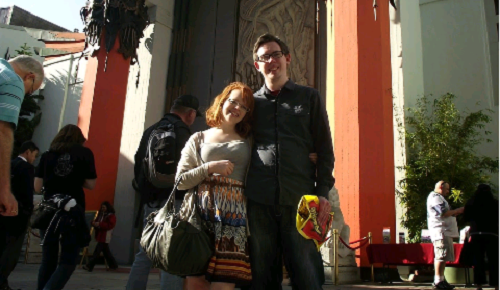
I got really jittery and worried when the plane took off. Think clutching-onto-the-seat scared. But it was so worth it. So worth the nine and a half leg-cramp-inducing hours to get to California. So worth it for the surreal sight of a massive picture of Barack Obama in LAX, bearing the words 'President Obama welcomes you to the United States of America.' I was too exhausted to get my camera out, but I wish I had done. It totally hit me then: I'm in America! We stayed with friends, whom we were desperate to see. That night we went to In-N-Out Burger after being awake for more than 24 hours. The waitress exclaimed over our accents, and weirdly, how nice I smelt, which was quite a nice compliment considering I had been travelling for over a day.
We squeezed in every drop of adventure that we could, big and small. We saw landmarks. We went to the tourist-crammed Hollywood and checked out the sizes of famous people's hands and feet. We had a picnic on the beautiful Venice beach and gawped at the mansions we saw on the drive there. We went shopping in Target and Walmart and I exclaimed over the amount of choice in the cereal aisle. We ate churros and enormous burgers and tub after tub of frozen yoghurt and weird flavours of Ben and Jerry's. Chris won a t-shirt for eating a ridiculously huge steak (and got jawlock in the process).
Most importantly, we spent time with amazing friends. I will never forget one particular night with them: a late evening in the hot tub, an impromptu Nerf gun war, an even-later visit to get some good old Frogurt, and then we sat down around the sofa and made predictions: what did we think would change the next time we saw each other? Some of these predictions were really specific. And they remain closed in a box, ready for the next time we go to visit them.
Our friends now live in Florida, enviably close to Disneyland. They also have a baby, a boy a few months younger than our girl (we joke that they are betrothed. I think my husband is quite serious about it actually). We have seen them once this year when they came to visit rainy Somerset to show off their gorgeously smiley baby boy, which was lovely. Chris and I still talk about our holiday all the time. When we are feeling a bit glum about our financial situation, or when we are on a rare 'date' away from our daughter, we pull out memories from sunny California. 'Do you remember when I ate that burger almost the size of my face? Remember when that guy totally conned you out of five dollars for a copy of his crappy rap album on Hollywood Boulevard?' Or we recall feelings: how it felt to drive out of L.A and see the beautiful mountains ahead of us. How exciting it was just to roam the streets and see real mailboxes and beautiful houses with big American flags waving in the breeze. How it felt to leave our friends at the airport, sad that it went by so fast, but with the idea in our heads that maybe soon we'd start a family. Sometimes we just like to remember how adventurous it felt to pack everything up and go somewhere completely new. For some people, hopping on a plane is just normal and nothing to worry about. For us, it was so unusual that it involved a bit of courage, to embrace change, to try something new.
I think it made me realise how important it is to make these memories. How we can have precious moments and big adventures at home, but we can have even bigger ones a little further afield. It made me realise how sometimes, you need to make decisions for the good of your heart and soul, not just the good of your bank balance. So eventually, one day, we want our daughter to experience the thrill of adventure, the experience of 'being' somewhere completely new. We want to take her to Florida, see our friends, let our children play, maybe fit in a quick trip to Disney. And maybe, open that box and see if our predictions were right.
Aviation's benefits beyond borders
In 2014, research calculated that aviation supports a staggering 63 million jobs and $2.4 trillion in GDP. This video sums it all up and you can read the report here.
To Tampa Bay and Beyond!
Aaron Heslehurst from the BBC reflects on how 100 years of commercial aviation have shrunk the globe.
Harrison Ford celebrated Flying100
2014 marked 100 years since the very first commercial flight, and in that time, the world contemplated just how far we'd come. We even had a message from a face you might recognize, Mr Harrison Ford. Aviation enthusiast Mr. Ford sent a message to the IATA annual general meeting 2014 to help celebrate the 100th anniversary.
100 years of commercial flight at Geneva Airport
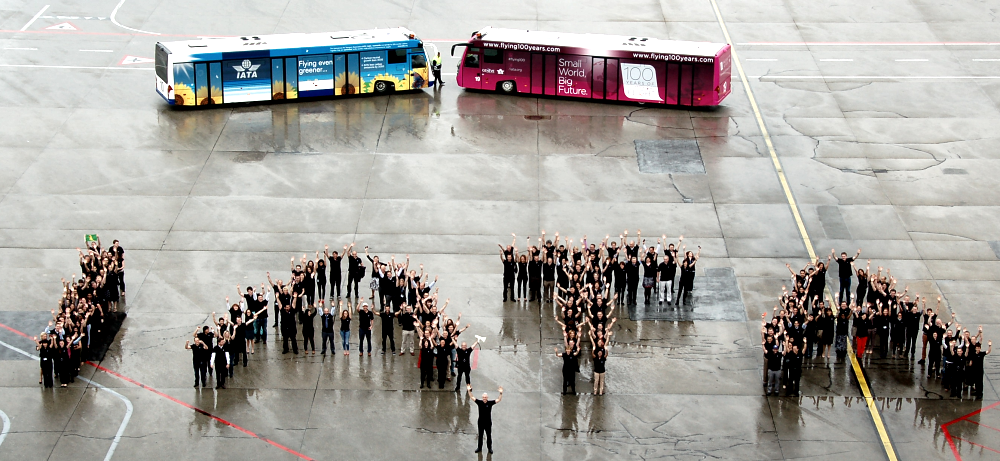
IATA’s executive office in Geneva, Switzerland partnered with the amazing ground crew at Geneva Intl Airport to celebrate Flying100. Coming together with the IATA airport buses, they made an 'IATA' format on the tarmac, to wish everyone around the world a happy 100th anniversary of commercial aviation.
Learn about the history of 100 years of commercial flight through the numbers.