Safety Leadership Charter, Guiding Principle 5: Create an atmosphere of trust, where employees are encouraged and confident to report safety-related information.
Safety Leadership Charter, Guiding Principle 6: Establish a working environment in which clear expectations of acceptable and unacceptable behaviours are communicated and understood.
During Aeromexico’s preparations for IOSA in the airline’s Maintenance division, the team realized that it was not compliant with its requirement to have a process in place to assess all risks, as the existing risk assessment and management process did not cover human factors.
Additionally, the team was aware that cases involving people were treated the same way, whether a malicious intent was involved or not. Mandated by the vice-president, the team therefore focused on two key objectives: ensuring compliance with IOSA requirements and improving the safety culture within the Maintenance area.
A positive safety culture is an integral part of the safety management system, and the first two behaviors Aeroméxico expects from its employees are safety and integrity. However, an organization cannot expect employees to be honest and raise their hand about safety risks when they may be held accountable for them in an arbitrary way. Staff need to feel confident that anything they say will be considered fairly.
That is the reason that in addition to its risk assessment committee, the airline decided to create a Just Culture committee. Aeromexico is very proud to be the first airline, perhaps in the world, that has such a committee for Maintenance.
As part of its risk assessment process, every event that involves human factors, is now referred to the Just Culture committee. Its members then identify if the persons involved acted intentionally or not, whether there was negligence, and what organizational weaknesses led to the event, so that they can be remedied.
Of course, to be accurate and fair in their evaluation, committee members need to come from every department, providing a holistic perspective to determine the root cause of an event and its impact. Aeromexico team had identified that it needed maintenance managers, quality assurance personnel, human resources staff, union representatives, safety people, and even accounting managers to be part of the Just Culture committee.
It was also essential that committee members have the same understanding of just culture, so that they could effectively evaluate human performance, as well as decide what course of action to take. It was therefore agreed that there was a need for training on these concepts.
Aeromexico had previously had Fatigue Risk Management System training with IATA, which prompted the team to think more about the effect of human factors, such as fatigue and circadian rhythm disturbances. Following this experience, the airline reached out to IATA for assistance on Just Culture training (“Just Culture in Civil Aviation”).
With 14 people trained from various departments, Aeromexico was able to put in place its Just Culture committee in the Maintenance division. This has changed how events involving human error were assessed.
For example, in one event, the team discovered that the person involved was suffering from fatigue due to the recent birth of their child, which is obviously not intentional. Whereas in another case, the person took shortcuts instead of following the procedures correctly, which is intentional. In both cases, the airline has a responsibility to investigate what needs to be changed within the organization, to prevent such situations from arising.
This meant the team needed to resolve all cases in a non‑punitive manner and update their processes and procedures to reflect that approach. By improving the organization in this way, the airline increases staff confidence and participation in maintaining safety, which is the basis of a positive safety culture.
It is still early days for Aeromexico’ Just Culture Maintenance committee. So far this year, the team has 28 resolutions of events. This could be a baseline for the team’s improvement efforts.
The team plans to launch a survey that includes questions on just culture, which they hope will:
Changes in approach, in acceptance and in mindset that signal a decisive start
Increase in hazard reports: One encouraging indicator the team has seen is an increase in reports of hazards, as compared to last year.
Union support: Another one is that union representatives are helping to promote positive safety culture, and the reporting of hazards.
Greater awareness of just culture principles and expanding implementation: Finally, other divisions have begun adopting this initiative, which signals that the organizational mindset is starting to change. Increasingly, people across the organization - not only within Maintenance - are discussing the principles of just culture.
Aeromexico’s Ground Operations division has also started implementing the same model. This will require additional training in Just Culture in Aviation for every division that follows the initiative, and, over time, further training in SMS, safety, and risk assessment for staff at many levels.
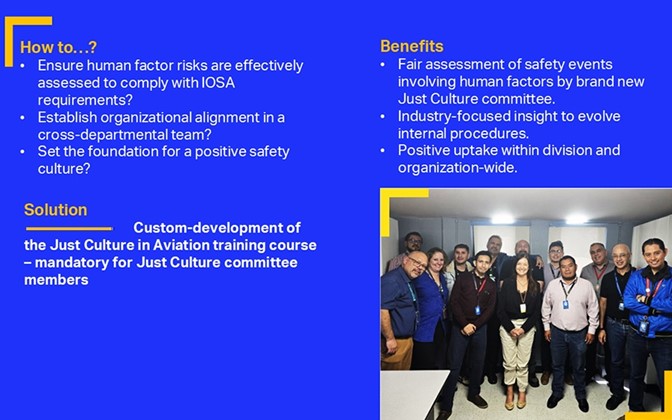
A diverse, cross-functional team and a hands-on approach: The experiences that were shared by the course instructor, along with the practical exercises, and the opportunity for participants to openly communicate their own experiences, made for an enriching learning environment. Several of the participants were managers themselves, with significant experience: from engineers who saw things from a regulatory standpoint to human resources professionals, who viewed them through a people, and company point of view. This exchange of perspectives really helped the team consolidate the concepts introduced by the instructor and begin developing approaches that would work well in their own environment.