
Safety Leadership Charter, Guiding Principle #2: “Foster safety awareness with employees, the leadership team, and the board.”
Safety Leadership Charter, Guiding Principle #3: “Guide the integration of safety into business strategies, processes, and performance measures.”
Safety is at the heart of Delta Air Lines’ mission. The number one value at Delta is to put Safety first, always, - whether on the ramp, in the air, in the airport, in maintenance facilities, at a desk or in a conference room. Providing a safe and secure operation is the fundamental obligation to customers, colleagues and the communities Delta is privileged to serve.
Operating one of the world’s largest airline networks – with over 1,300 aircraft and 5,000 daily departures, supported by more than 100,000 employees – Delta recognizes that Safety Leadership is not just a policy – it is a culture that must be lived every day.
In 2017, Delta was among the first airlines to receive U.S. Federal Aviation Administration (FAA) validation for SMS, and it continues to enhance its approach as best practices evolve.
Building on this commitment, in September 2023, Delta signed the International Air Transport Association (IATA) Safety Leadership Charter, which includes eight Safety Leadership guiding principles.
As one of the first signatories of the IATA Safety Leadership Charter, Delta has taken deliberate steps to strengthen safety behaviors across all levels of the organization, ensuring that every decision and action reflects its core value: Safety First, Always.
IATA Safety Talk by Delta CEO Ed Bastian
To bring the Charter’s guiding principles to life, Delta launched its Intentional Safety Culture Initiative – an effort to weave safety leadership behaviours into everyday operations. This initiative drives meaningful change through a number of actions, with some of the key actions listed below:
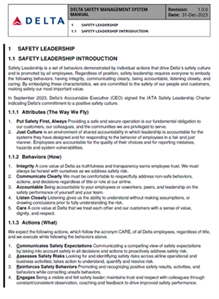
As the SMS Accountable Executive, Delta’s Chief Executive Officer (CEO) retains ultimate responsibility for the SMS and Delta’s safety performance. Delta’s SMS is a comprehensive approach to occupational and operational safety, focused on identifying hazards, assessing and mitigating risk, monitoring safety performance and promoting a positive safety culture.
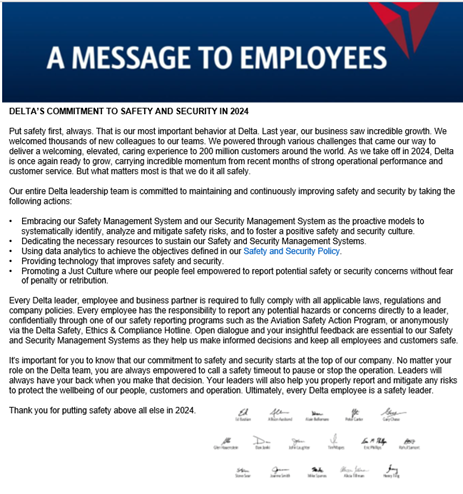
Senior Leadership’s Annual Safety Commitment Letter
On New Year’s Day, the Delta Leadership Council (DLC) releases the Delta Commitment to Safety and Security in an email to Delta employees worldwide. This letter reinforces Delta’s most important behavior “Put safety first, always.” There is also information about positive safety culture (acceptable and unacceptable behaviors) as well as the leadership teams’ commitment to improving safety at Delta.
Delta’s annual Safety Day occurs each June where executives, operational leaders, and frontline employees come together to promote safe behaviors.
Annual Flight Safety Conference that brings together safety professionals in Flight Safety, Flight Operations and the Delta pilot union, ALPA. This conference brings in leaders from manufacturers, regulatory agencies, safety boards, and education institutions to talk about current risks and how the teams can work together to reduce the safety of flight risk.
Executive Station visits: Town hall-style listening and feedback session where senior leadership have candid conversations with frontline employees.
VELVET: Over the past 20 years, Delta has hosted a conference experience known as VELVET for our frontline employees. Billed as the ultimate employee engagement experience, VELVET allows frontline employees to meet and hear directly from senior leaders and share their feedback to help shape the company's future.
Employees learn about company strategy and key initiatives from our CEO and other senior executives at every VELVET. They attend breakout sessions to hear from their divisional leadership, participate in Q&A sessions with the CEO and other executives, and enjoy an evening of networking with their peers and Delta leaders. These sessions are open to all frontline employees and safety is always a key talking point throughout the two-day event.
These major, large-scale events are supported by key safety message that are available to all Delta people in digital employee channels as well as in high traffic locations like break rooms year-round. Examples of key messages:
Communication of safety messages is consistent and embedded in divisional and enterprise communications and includes an emphasis on learning from past events.
The main challenge is aligning a combined safety culture across diverse operational divisions, both from a cultural (geographic location) perspective and past practice. This includes the understanding that SMS is not meant to be a separate bureaucratic process but instead imbedded in day-to-day activities.
At Delta, we have modified the term Just Culture to a Positive Safety Culture to more accurately reflect our commitment to a safety culture that rewards good behavior but does not condone reckless or intentional misconduct. It is critical that the safety policy defines both acceptable and unacceptable behaviors. At Delta, our Positive Safety Culture states:
Delta is committed to the principles of a Positive Safety Culture, where employees and partners are empowered to report hazards and mistakes, leaders are accountable for responding in a fair manner, and we are all committed to continuous improvement. We understand that people sometimes make mistakes while trying to do the right thing, but we cannot tolerate reckless behavior or conscious disregard for Delta’s policies and procedures or other regulations. Employees engaging in unacceptable behavior involving any of the following are subject to disciplinary action, up to and including termination of employment:· Illegal activities
The biggest lesson learned is that visible leadership commitment and continuous communication is crucial for safety culture change. Culture change does not happen overnight, and it takes intentional changes across the entire organization.


