


Unlocking EEUs is key to allow airlines to offset CO2 emissions above the established CORSIA baseline and to comply with regulatory requirements.
Under CORSIA, airlines must purchase and cancel “emissions units” to offset the increase in CO2 emissions covered by the scheme. Airlines are expected to purchase around 200 million CORSIA EEUs by January 2028, at an estimated value of USD 4–5 billion. That figure could increase to nearly 2 billion EEUs through 2035.
To maximize CO2 emission reductions under CORSIA, states must offer sufficient quantities of EEUs, the carbon offset credits that meet the strict eligibility criteria defined by ICAO. At the same time, the host countries must authorize the usage of those units for the purpose of CORSIA by conducting corresponding adjustments, to ensure the EEUs are not double claimed as part of a country’s NDC under the UNFCCC Paris Agreement. Hence, there is an obligation put on airlines to purchase the EEUs, but for the countries it is optional whether to release EEUs to airlines, which leads to a scarcity of CORSIA EEUs.
Supporting Alliance for CORSIA EEU Supply
IATA is uniting national governments and the leading CORSIA EEU suppliers, investors, experts, and civil society through the formation of the Supporting Alliance. Signatories of the Aviation Carbon Market Compact constitute the Alliance and commit to pursuing the aim of increasing the supply of CORSIA EEUs to 225–250 million emissions units by spring 2027, based on their role in the market for CORSIA EEUs.
The Alliance is open to any organizations and national governments that significantly contribute to the development of CORSIA EEU supply and the robust implementation of CORSIA and the Article 6.2 guidance of the Paris Agreement.
The members of Alliance will be convened regularly to share information on the progress of CORSIA EEU supply, their current efforts, and any remaining or emerging barriers to CORSIA EEU supply.
For more information about this effort or to join the Supporting Alliance’s growing community of national governments, carbon market participants, and airlines, contact CORSIA@iata.org.
> Download the Aviation Carbon Markets Compact (pdf)
State Signatories
- Guyana
- Madagascar
- Peru
- United Kingdom
- Zambia
- Zimbabwe
Other Signatories












































































Host Country Assistance
IATA is working with reputable Article 6 and CORSIA experts to provide implementation assistance to host Parties seeking to adopt strong strategies for authorizing the use of domestic emissions units under CORSIA ahead of the compliance deadline for the first phase of the CORSIA and for Parties’ reporting and review processes.
IATA and other partners are currently offering to host countries, based on each country’s individual needs and its Paris Agreement Article 6.2 implementation status, for example:
- Sustained technical assistance for a full Article 6.2 authorization, reporting, and review cycle.
- Scoping both opportunities and necessary steps for providing authorizations in 2026, including
- options for attracting carbon finance to activities, technologies in greatest need, per NDCs
- suitable models and timing for authorizations
- benefit-sharing and other NDC risk management mechanisms
- As-needed processing of Article 6.2 Technical Expert Review recommendations and responses.
- For existing LoAs and Article 6.2 Reports pertaining to CORSIA—Identifying options to strengthen alignment with Article 6.2 guidance or CORSIA.
- Other support and benefits as relevant.
E-mail CORSIA@iata.org to inquire about participation or for more information.
Guidance Document
To facilitate access to EEUs, IATA has organized a EEU Procurement Event for airlines only, together with State of Guyana, Mercuria and Xpansiv.
In addition, IATA, together with IETA, A6IP and ATAG, produced a Guidance Document for Host countries concerning the issuance of CORSIA Eligible Emissions Units (pdf) to provide State Parties under UNFCCC with a comprehensive overview of CORSIA emissions unit criteria, highlighting their responsibility to implement corresponding adjustments to guarantee the environmental integrity of CORSIA eligible emissions units. It outlines the essential steps involved in issuing a Letter of Authorization and applying corresponding adjustments, taking into account the recently adopted operational rules of Article 6 of the Paris Agreement.
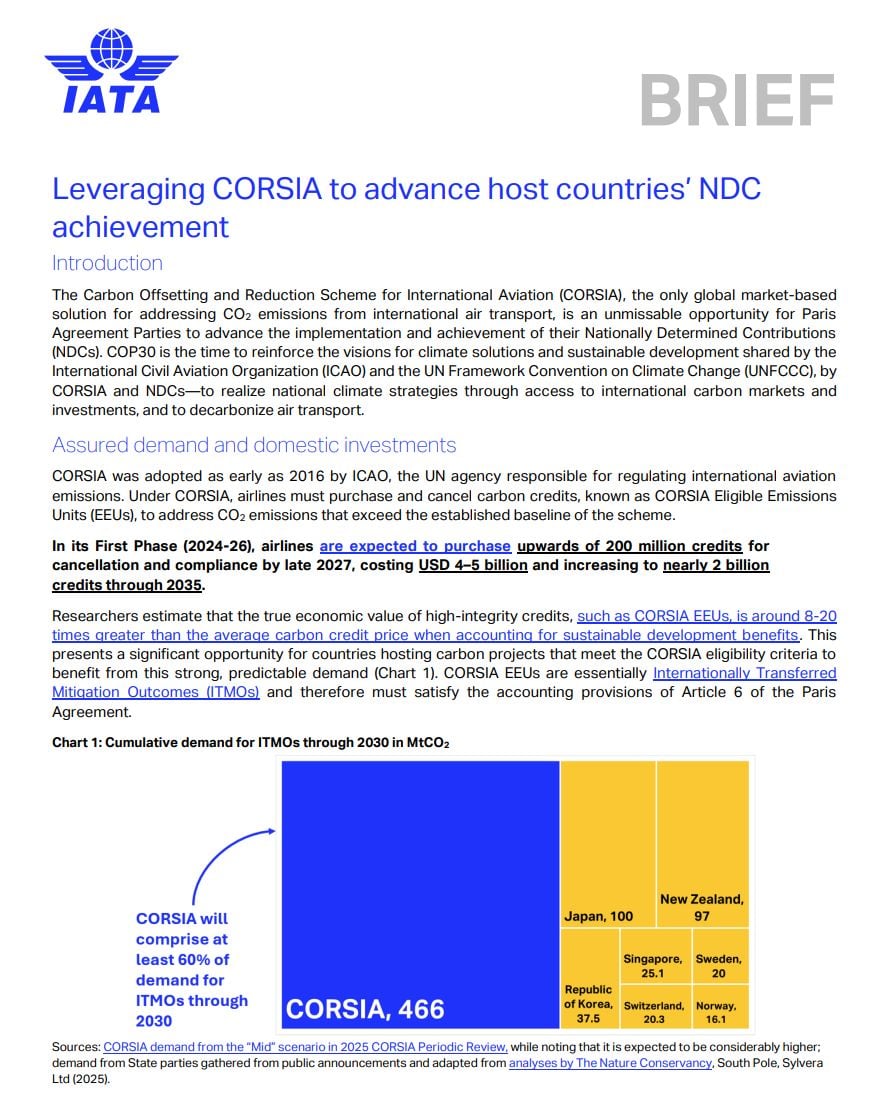
Leveraging CORSIA to Advance Host Countries’ NDC Achievement
CORSIA is an unmissable opportunity for Paris Agreement Parties to advance the implementation and achievement of their Nationally Determined Contributions (NDCs). COP30 is the time to reinforce the visions for climate solutions and sustainable development shared by the International Civil Aviation Organization (ICAO) and the UN Framework Convention on Climate Change (UNFCCC), by CORSIA and NDCs—to realize national climate strategies through access to international carbon markets and investments, and to decarbonize air transport.
> Read the brief: Leveraging CORSIA to advance host countries’ NDC achievement (pdf)
Urgent Call for Host Country Action
Joint statement from IATA and 21 other signatories urges governments to issue Host Country Letters of Authorization (LoAs) as per the Paris Agreement. The purpose is to enable the release of CORSIA Eligible Emissions Units (CORSIA EEUs), which are crucial for maintaining the environmental integrity of CORSIA and ensuring a functional market for these units. Read the statement (pdf)
Host Countries that Have Signed LoAs
Authorizing the use of qualifying EEUs under the first phase of CORSIA is an unmissable opportunity for Parties to the Paris Agreement to implement and achieve their Nationally Determined Contributions (NDCs) under the Agreement while also sustaining the implementation of CORSIA.
Below is a list of host countries that have provided CORSIA-compatible LoAs.
Frequently Asked Questions
What are EEUs?
Under CORSIA, airlines cancel carbon credits known as CORSIA Eligible Emissions Units (EEUs) to offset CO2 emissions that exceed a global emissions baseline.
Unlocking EEUs is key to allow airlines to offset CO2 emissions above the established CORSIA baseline and to comply with regulatory requirements.
Under CORSIA, airlines must purchase and cancel “emissions units” to offset the increase in CO2 emissions covered by the scheme. To maximize CO2 emission reductions under CORSIA, states must offer sufficient quantities of EEUs, the carbon offset credits that meet the strict eligibility criteria defined by ICAO. At the same time, the host countries must authorize the usage of those units for the purpose of CORSIA by conducting corresponding adjustments, to ensure the EEUs are not double claimed as part of a country’s NDC under the UNFCCC Paris Agreement. Hence, there is an obligation put on airlines to purchase the EEUs, but for the countries it is optional whether to release EEUs to airlines, which leads to a scarcity of CORSIA EEUs.
Why are EEUs important for aviation’s decarbonization?
EEUs play a critical role because aviation does not yet have enough scalable alternatives to fully replace fossil jet fuel.
They allow airlines to take responsibility for emissions today, while technologies like sustainable aviation fuel and new propulsion systems continue to scale.
At the same time, EEUs direct finance to climate projects around the world, helping to reduce emissions beyond the aviation sector and supporting global climate action.
Why are government approvals (LoAs) so important?
Government approvals—known as Letters of Authorization—are essential because they confirm that emissions reductions will only be counted once.
They ensure that the same emissions reduction is not used both by the country toward its own climate targets and by an airline under CORSIA.
Without these approvals, credits cannot be used under CORSIA, which effectively blocks supply and delays climate finance flowing to projects.
How do EEUs benefit countries and communities?
EEUs channel finance directly to projects that reduce emissions, often in developing countries.
The revenue generated helps fund activities such as forest protection, renewable energy, or community-based climate programs.
This creates a strong incentive for countries to participate, as it supports both their climate goals and local economic development.
What is IATA’s role in accelerating availability of EEUs?
IATA’s work with reputable experts and host countries to promote strong strategies for Letters of Authorization (LoAs) that will keep CORSIA and the Paris Agreement implementation on track. IATA supports the availability of CORSIA EEUs by enabling market access and safeguarding environmental integrity. IATA also facilitates transparent access for airlines through dedicated procurement events and supports the robust application of ICAO eligibility criteria to ensure CORSIA delivers real and credible emissions reductions.