
CBTA has been two decades in the making, yet only three airlines worldwide have fully implemented it in line with ICAO provisions. Most organizations measure competencies but stop short of designing the courses that develop them, and that is where compliance breaks down. Here is what a fully compliant flight operations CBTA program takes, and how to get there.
It has now been 20 years since competency-based training and assessment (CBTA) was first introduced in flight operations, with the publication of ICAO standards for the Multi-crew pilot license (MPL). In the following years, it was expanded across several groups of licensed aviation personnel, including aircraft maintenance personnel, air traffic controllers, and flight dispatchers. Forming the Competency-Based Training and Assessment Task Force in 2014, ICAO set to defining the details for the implementation of CBTA, releasing Amendment 5 to Doc 9868, PANS-TRG, in 2016, which described a generic methodology for designing CBTA.
With the foundation established, the industry has seen progressively more guidance in this second decade. Amendment 7 of the PANS-TRG, published in 2020, extended CBTA’s applicability to all licensing and operator training, and ICAO’s Personnel Training and Licensing Panel, formed in 2021, aims to provide further direction on how to develop and implement CBTA programs.
Today, however, few organizations are 100% CBTA-compliant. Currently, three airlines worldwide have fully implemented CBTA in accordance with the ICAO provisions, and China is the only state with a plan to replace (by 2030) traditional training with CBTA, and make its licensing system and operating requirements compliant. Where do other states and organizations stand at this point?
The first organizations to implement CBTA were approved training organizations (ATO) and air operators (AOC) choosing to adopt MPL and evidence-based training. The programs put into place were for pilots and, later, for maintenance personnel. At some airlines, as well as applying to all licensed employees – flight crew, dispatchers and maintenance – CBTA now covers those who do not require a license, such as cabin crew and ground staff. Outside of airlines, air traffic management staff, including on-the-job instructors, as licensed personnel, have also come under the scope of CBTA. The main regions to implement the new methodology are Europe, the Middle East, Asia and Australia.
Implementation, however, is less well developed than it appears. Organizations have mainly focused on performance assessment through a CBTA framework, enabling them to identify where to focus their training development efforts. While stakeholders may think they are compliant, they are not.
A CBTA program is not just about measuring human performance. It is also about designing courses to ensure that the competencies that are required, (and that performance assessment might pinpoint), can be developed effectively and efficiently, and this means applying an instructional system design (ISD) methodology. The resulting courses need to address not just technical and procedural knowledge and skills, but the ability to apply them in situ and under stress. Competency-based training therefore integrates communication, teamwork, and leadership, which are key to effectively managing workload or building on situational awareness.

In an increasingly complex aviation environment, with constant schedule modifications, more technology and automation at every level, and more teams with wide disparities in experience, the potential for human error and external threat has never been higher. CBTA enables organizations to ensure their personnel can manage high-pressure situations – whatever they are – safely and effectively. Additionally, with worldwide adoption, global safety enhancements are expected, as CBTA data analysis sustains more proactive-predictive hazard identification.
In its guidance material, IATA defines competency-based training and assessment programs as “performance-based training programs that integrate per design a continuous monitoring and evaluation of the course.” Competency assessment as evoked above is a fundamental component, but not the totality of the program. To be CBTA-compliant, training and assessment must be standardized to include1:
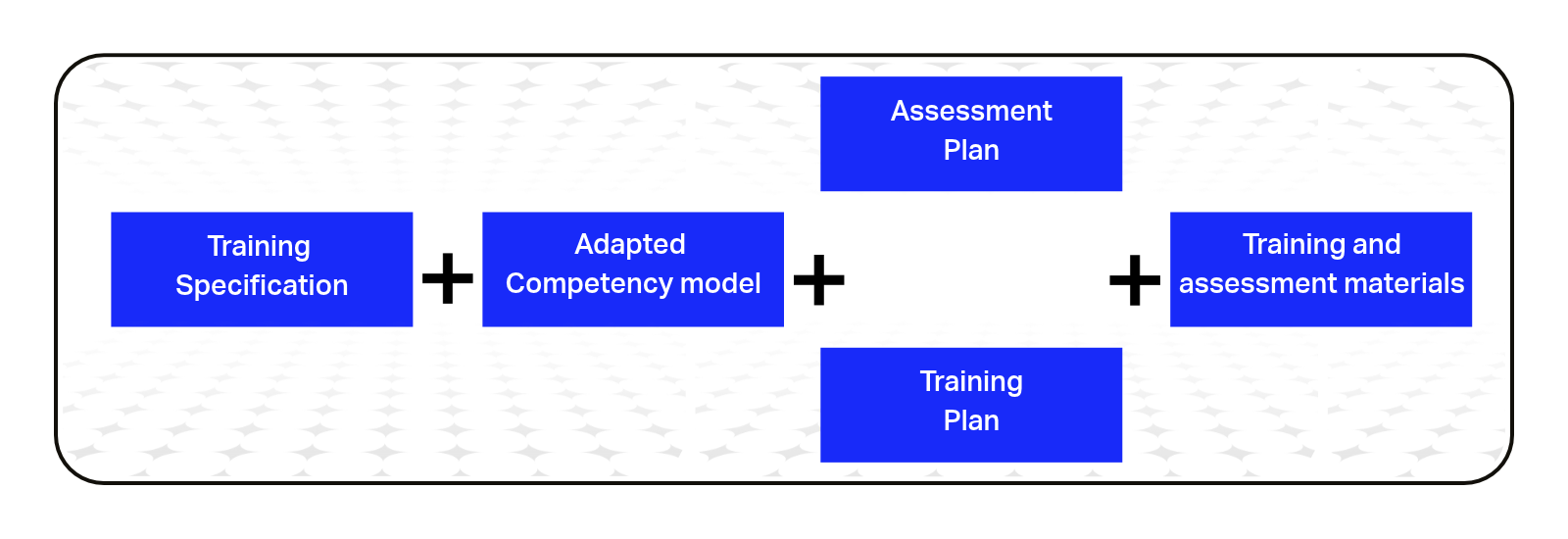
CBTA represents a major shift in training program design and development compared to traditional training, and ICAO PANS-TRG (Doc 9868) therefore states that “course developers shall have demonstrated that they are able to develop training and assessment in accordance with the principles of a competency-based approach to training”.

Traditional training identifies tasks that are repeated until the technical outcome is achieved and the box can be checked off. CBTA identifies a set of competencies that individuals need to apply to safely and effectively carry out their activities. While learning how to complete the tasks, students develop the necessary competencies, which can be observed through the way they behave. Trainers look for this demonstration of observable behaviors, and identify the root causes of under-performance in order to correct where necessary.
In this context, the role of the course developer becomes as important as that of the instructor delivering the training. With CBTA, the course developer ensures progressive and consistent competency development during the training, through the design and
development of the program. Instructors, licensed experts who have been assessed as demonstrating defined instructor competencies
Despite the rapid expansion of CBTA that we have witnessed in the last decade, implementation in full accordance with ICAO principles and procedures remains uneven, indicating that organizations face challenges in developing and executing such programs.
On the regulatory side, while some 75% of regulators permit CBTA (according to an ICAO survey conducted in 2023 among its member states), they lack expertise and resources to approve CBTA programs and carry out oversight of organizations conducting these programs, as required by the Annex 19 provisions. In particular, the survey stressed the lack of regulatory guidance and regulatory requirements to guide such efforts.
On the industry’s side, different information sources have highlighted the need to train and standardize course developers and instructors transitioning from traditional training to CBTA. ICAO Doc 9868, PANS-TRG, contains the provisions to develop CBTA programs, but there is a need to provide extra guidance and support to AOCs and ATOs to grow their capacity and resources to develop and implement CBTA programs in compliance with the ICAO principles.
As the leading reference on CBTA implementation, IATA is a key contributor to ICAO’s Personnel Training and Licensing Panel, regularly publishes guidance material, and advocates with regulators. It is also developing targeted programs to build regulatory oversight capacity – a pre-requisite for successful CBTA adoption – and enable standardization of course development and instruction:
| IATA CBTA for Civil Aviation Safety Inspectors (CASIs) Standardization course | Standardization for CBTA Course Developers | CBTA Train the Trainer – Pilots course |
|---|---|---|
|
This course equips state inspectors to approve CBTA programs for flight crew training, and to carry out oversight of the air operators and Approved Training Organizations (ATOs) delivering the programs. |
This course allows organizations to design and develop CBTA courses in compliance with ICAO provisions and IATA best practices. The Pilot Training curriculum is already available. The is expected by end 2026. |
This course gives standardizers the necessary competencies to effectively train and assess instructors according to the competency framework defined by ICAO |
CBTA has been two decades in the making. The regulatory framework is in place, and the tools exist to make it work. What remains is the will to close the gap between assessment and full compliance – and the knowledge of what that actually requires.


