
Modern travelers expect flexible, innovative booking options, such as mixing economy and business cabins in one trip, booking for large groups beyond legacy limits, or buying multiple seats for privacy. These are not niche scenarios - they represent the future of airline retailing and significant revenue opportunities. Yet tradition airline systems cannot support use cases. The offers customers want require fundamental changes to how airlines create, price, sell and service their products. The retailing revolution is not about distribution channels - it is about what you can sell through them.
For the past 10 years, New Distribution Capability (NDC) adoption has been the industry’s focus – and rightly so. It is the essential first step towards modern airline retailing. Tailored offers, dynamic pricing, enhanced servicing and seamless customer experience dominated the conversation, with leading airlines invested heavily in NDC technology, seller onboarding and new commercial strategies.
But distribution capability alone does not transform retailing. NDC gives you control over how offers reach customers. Offer, Order, Settlement, and Delivery (OOSD) covers the full offer-to-service lifecycle; from offer creation through service delivery and follow-up transactions.
The difference is profound. As the industry shifts from NDC implementation to retailing innovation, airlines that grasp this distinction will capture revenue opportunities others cannot.
TPConnects' Astra NDC, deployed by carriers such as EgyptAir on NDC 24.4, illustrates the maturity of airline distribution technology. NDC 24.4 advances this further by introducing streamlined order management, enhanced servicing, and improved order accounting. “24.1 and beyond” is a new generation of schemas that builds on learnings and improves support for Offers and Orders. It is more than a technical refresh: it is part of making the standard easier to scale across more complete retailing and transaction needs. Recent innovations extend beyond standards compliance into intelligent retailing capabilities - paving the path from distribution readiness to modern airline retailing.
AI assistants are becoming the new front door for travel shopping. Astra's Model Context Protocol (MCP) capabilities ensure that when travelers use AI tools to search for flights, your airline's NDC content – from basic fares to seat options to cabin choices – is structured, accessible and properly presented.
The true value of OOSD becomes clear when examining scenarios that modern travelers expect but legacy systems cannot deliver:
Traditional airline systems rely on rigid, ticket-central architecture across multiple disconnected systems with inflexible documents that cannot adapt to modern retail scenarios.
Scenario 1: Mixed Personal and Business Travel
The Need: A passenger books economy outbound (window seat, special meal) and flexible business class return. This means - different cabins, bundled ancillaries, flexible rules all purchased through a single transaction.
OOSD Solution: The Product Catalogue enables mixed-cabin journeys as a single product. Offer management assembles personalized offers dynamically. When return dates shift, Order Management processes changes automatically with real-time visibility.
Scenario 2: Large Party Booking
The Need: Three families of 12 passengers need coordinated seating in one purchase.
OOSD Solution: Stock Keeper removes legacy passenger limits, treating inventory as flexible retail space. When one family cancels, Order Management handles the partial cancellation at family level, recalculates automatically, and processes refunds in real-time.
Scenario 3: Premium Privacy Products
The Need: A single passenger purchases an entire row for comfort and privacy on a long-haul flight - treating seats as a premium product, not just inventory.
OOSD Solution: Product Catalogue defines “Privacy Row” as a purchasable product. Stock Keeper allocates three seats to one passenger as a single unit. Order Management treats it as one order item throughout the journey.
These real-world scenarios are standard in other industries and already expected by travelers. Airlines with OOSD capabilities can deliver them; those without cannot, no matter how advanced their NDC distribution is.
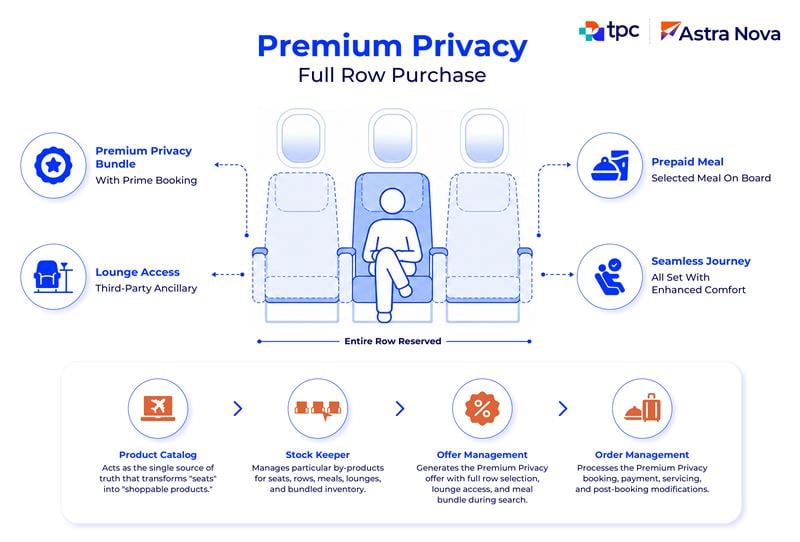
OOSD represents the foundational shift from ticket-centric operations to order-based commerce. It is built on four interconnected capabilities:
Centralizes product definition, allowing airlines to easily create, bundle, and distribute innovative offers (e.g., mixed-cabin journeys or branded packages) as business-driven products rather than IT workarounds.
Modernizes inventory management, treating seats and services as flexible retail assets and enabling non-standard products like bundled ancillaries or multi-seat “privacy row” purchases.
Dynamically assembles and prices personalized, real-time offers by combining products, inventory, rules, and availability, making complex, multi-passenger or bundled bookings seamless.
Replacing rigid tickets with flexible, living orders that support changes, partial cancellations, post-purchase upsells, and automated financial reconciliation.
Most airlines cannot replace their legacy PSS overnight due to contractual, operational, and regulatory constraints. TP Connects’ Astra Nova addresses this by running alongside existing systems, using bi-directional synchronization so orders and changes stay aligned between OOSD and the PSS. This allows airlines to migrate gradually, starting with controlled channels, expanding to direct and indirect sales, adding modern retailing capabilities step by step without disruptive system replacement.
NDC implementation remains essential and continues to gain global momentum, but airlines are increasingly recognizing that effective distribution depends on modern retailing foundations. IATA’s ONE Order standards provide the framework, while platforms like Astra Nova turn that vision into operational reality. Airlines that move early are already seeing gains in ancillary revenue, lower servicing costs, and higher customer satisfaction.
Those that act now can deliver differentiated products, greater flexibility, and unlock revenue scenarios legacy systems cannot support. Those that delay risk modernizing distribution without modernizing retailing. NDC modernizes distribution; OOSD enables true airline retailing. Both are essential - and both are underway.
Author: TPConnects Technologies
*Find out more about TPConnects Technologies' engagement in the IATA's Strategic Partnerships Program on the partners directory.


