
The publication of Sweden's new Aviation Strategy is an important milestone for the country's transport policy. At a time when aviation across Europe faces economic, geopolitical and environmental pressures, the Strategy recognizes the essential role air connectivity plays in supporting Sweden's economy, regional cohesion, and international competitiveness. From the airline industry's perspective, it is a welcome and pragmatic roadmap, balancing decarbonization with the need to maintain a competitive and resilient aviation sector.
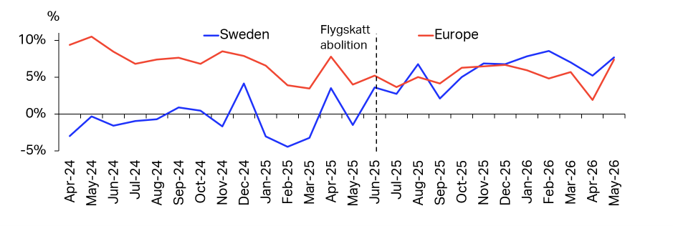
The publication of the report comes almost one year after the elimination of the Swedish air passenger tax. This bold measure was taken by the Swedish government in recognition that the country’s air services had not recovered as quickly post pandemic as its European peers. It is too soon to definitively say that the tax cut has helped turn around the fortunes of the Swedish market. But our latest analysis notes that in the period Q2 2024-Q2 2025, passenger numbers in Sweden fell 1% while the rest of Europe grew 7%. In the period Q3 2025-Q2 2026 (since the tax abolition) Sweden has grown 6% compared to wider European growth of 5%. So, Sweden has gone from severely underperforming to outperforming the European market.
Change in passenger traffic, number of passengers, % YoY
“The strategy's emphasis is on keeping Sweden competitive within the European aviation market. The removal of the aviation tax sent an important signal that policy should support connectivity. And the Aviation Strategy is combining this with efforts to avoid unnecessary national regulations that could disadvantage Swedish aviation,” says Catrin Mattsson, IATA’s Area Manager for Nordic and Baltic.
The strategy recognizes the pressures facing airlines and airports. Rising fuel costs, geopolitical instability, shifts in travel demand and the cost of meeting ambitious European climate policies are placing significant pressure on the sector. The projected costs of sustainable aviation fuel requirements and emissions trading underline the importance of ensuring Sweden remains an attractive and competitive aviation market.
Airlines have consistently argued that climate ambitions require coordinated European and global action rather than fragmented national measures. Sweden's commitment to working through the European Union and the International Civil Aviation Organization reflects this reality and will help ensure a level playing field for airlines operating across Europe.
The strategy also places innovation at the center of Sweden's aviation future. Research into sustainable aviation fuels, electric aircraft, hydrogen technologies and advanced aerospace capabilities builds on Sweden's strengths in innovation and engineering. With abundant renewable energy resources, a strong aerospace sector and effective collaboration between government, academia and industry, Sweden is well placed to lead in next-generation aviation technologies.
Importantly, the report recognizes that sustainability and competitiveness must progress together. Decarbonizing aviation will require significant investment, technological innovation and supportive policy frameworks. Success cannot be achieved by airlines alone: governments, fuel producers, airports, manufacturers and regulators all have critical roles to play. The Strategy's emphasis on partnership, dialogue and evidence-based policymaking provides a solid foundation for that collaboration.
The Strategy rightly acknowledges that aviation is far more than a mode of transport. For a geographically large country with dispersed communities, air services are part of the national infrastructure.
“The Government's commitment to strengthening aviation infrastructure is particularly encouraging,” says Mattson. “The focus on developing Stockholm Arlanda Airport as Sweden's primary international gateway, alongside investment in improved road and rail access, demonstrates an understanding that strong hub airports are fundamental to national competitiveness.” Recognition of the essential role played by regional airports also reflects Swedish geography: these airports provide vital connectivity for communities, businesses, healthcare and emergency services while strengthening national resilience and civil preparedness.
There is also welcome recognition that maintaining and expanding international connectivity is essential for Sweden's future prosperity. Supporting new direct air services, strengthening Scandinavian cooperation and improving access to international markets will benefit businesses, attract investment and enhance Sweden's global competitiveness.
As implementation begins, continued engagement with the aviation sector will be essential to translate these ambitions into practical outcomes. Infrastructure investment, regulatory reform, and support for innovation will all require sustained attention over many years.
“Overall, Sweden's new aviation strategy sets out a positive and balanced vision for the future. It recognizes aviation as a strategic national asset, acknowledges the challenges facing the sector, and proposes practical measures to strengthen competitiveness while advancing sustainability.
The airline industry welcomes this constructive approach and looks forward to working with government, airports and partners across the aviation ecosystem to ensure Sweden continues to benefit from a safe, connected, competitive and increasingly sustainable aviation sector for decades to come,” says Mattsson.
Additional information:


