
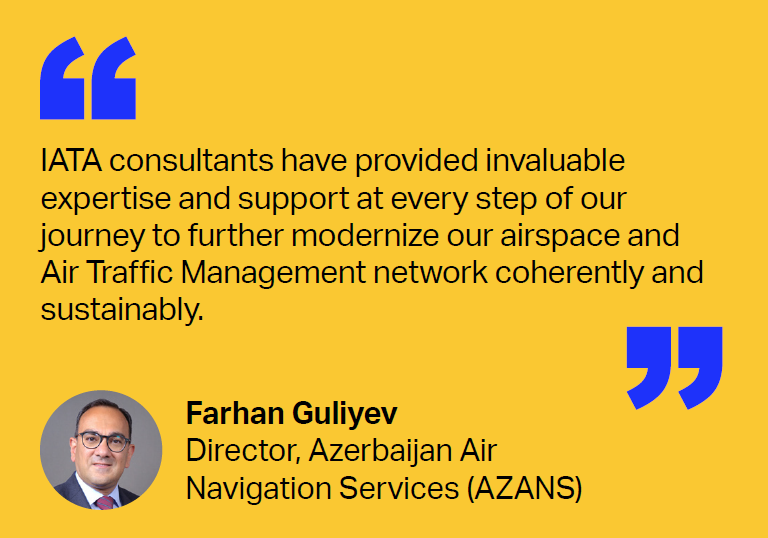
Farhan Guliyev Director, Azerbaijan Air Navigation Services (AZANS)
In the face of increased air traffic and forecasts of significantly more to come over the next decades, "Azeraeronavigation" Air Traffic Department (AZANS) of CJSC Azerbaijan Airlines (AZAL) turned to IATA Consulting to help them develop and implement a National Airspace Strategy. Director Farhan Guliyev explains.
Established in 1996, AZANS is the responsible body for air traffic control within the airspace of the Azerbaijan Republic, which encompasses 86,600 km2 over land and 78,800 km2 over the Caspian Sea, for a total of 165,400 km2. With around 11,000 km of route network within its airspace, the Azerbaijan Republic borders Kazakhstan, Turkmenistan, Russia, Iran, Georgia, Armenia and Turkey, and therefore occupies a key geographic position between Europe, Asia and the Middle East. Azerbaijan is a member state of the European Civil Aviation Conference (ECAC).
How to...?
IATA Consulting’s solution:
Benefits
Azerbaijan is strategically located at the crossroads of Europe and Asia. By the beginning of 2023, we had seen a clear shift in regional traffic flows. Our airspace had become a critical transit corridor between continents, and forecasted increases in passenger demand, of 80% over the next twenty years, made it even clearer that our air navigation system needed to be able to handle this rapid and sustained growth safely, efficiently, and sustainably.

Additionally, our country had already begun to modernize its aviation ecosystem, starting construction of Lachin International Airport in 2021, and of the cargo-focused Alat International Airport in 2023 – key components of our national ambition to become a leading regional aviation hub. This goal demanded a comprehensive, forward-looking roadmap, that included these two major projects and took into account global best practices. The projects themselves of course required an integrated strategic framework that would ensure airspace design was optimized, infrastructure investment was aligned, and that our operational performance would be enhanced.
We therefore took the decision to develop and implement a National Airspace Strategy (NAS). Its objectives would be to ensure traveler safety across our controlled airspace; strengthen our country’s competitiveness as an aviation and logistics hub; and align with ICAO and EUROCONTROL standards and objectives, particularly regarding sustainability.
We had previously collaborated with IATA Consulting, in 2020-2021, to enhance our Safety Management System (SMS). The project was very successful, significantly strengthening our safety oversight and organizational safety culture, and we had noted the professionalism of IATA’s consultants. Their deep understanding of international standards, and their hands-on experience with states and ANSPs worldwide, as well as IATA Consulting’s proven global expertise in airspace modernization and strategic planning, gave us confidence that the NAS would not only meet international and European requirements, but also reflect Azerbaijan’s unique regional context and ambitions.
We officially announced the program in February 2023 and, in line with ICAO and EUROCONTROL methodologies, the first phase was to fully assess our current airspace structure, air traffic flows, capacity constraints, and technology infrastructure. This phase also included benchmarking against leading ANSPs and regional peers to identify opportunities for optimization, and it lasted until the end of the third quarter of 2023. IATA Consulting worked hand in hand with our teams at AZANS, providing us with a comprehensive, end-to-end methodology that combined technical precision, operational know-how, and international best practices into a solution fully tailored to Azerbaijan’s unique strategic context.
During the second phase, up to mid-2024, the NAS framework was developed to meet our three main objectives. Its action plan aimed to improve flight efficiency, and reduce delays and route complexity for travelers. To foster economic development for our country, the plan aimed to increase route capacity, support the expansion of air cargo, and attract more international carriers. To ensure sustainability, it aimed to optimize route structures, reduce fuel burn and CO2 emissions, and introduce performance-based navigation and digital air traffic management technologies.

With these goals in mind, IATA Consulting worked in close collaboration with our teams to define the target architecture for the airspace system, performance indicators, and a detailed modernization roadmap, which includes the integration of Performance-Based Navigation (PBN), Flexible Use of Airspace (FUA), and digital air traffic management (ATM) concepts. IATA’s consultants provided exceptional value at this stage: modeling operational scenarios, conducting safety and efficiency analyses, and ensuring that every recommendation was harmonized with ICAO’s Aviation System Block Upgrade (ASBU) framework.
The third – implementation – phase, which is expected to conclude at the end of 2026, gradually transitions AZANS to the new airspace design, engaging stakeholders and deploying technology as we go. It includes enhanced cross-border coordination, training of air traffic controllers, and the introduction of new surveillance and automation systems. To build a unified understanding of the benefits of the strategy, IATA’s consultants have facilitated workshops with AZANS and national stakeholders, and they have played a crucial part in communicating the NAS vision across government, airlines, and regional partners.

The implementation of the National Airspace Strategy (NAS) has enabled us to elevate performance to a new strategic level, ensuring travelers’ experience when they fly through our country remains safe and seamless. Since its launch in 2024, our airspace capacity has increased significantly as we have optimized route structures and refined sectorization. While AZANS already maintained world-class safety and operational records prior to the NAS — with zero ATFM delays in 2022 and no ATM-related incidents for five consecutive years — airlines operating in Azerbaijani airspace are already reporting shorter flight times, higher route efficiency, and smoother tactical flow management. The introduction of PBN and flexible airspace management, along with the deployment of have strengthened predictability, situational awareness, and overall safety.
The strategic framework of the NAS smoothly integrates the new international airports of Lachin and Alat, both of which contribute to our objective of strengthening Azerbaijan’s competitiveness as an aviation and logistics hub. Lachin extends controlled airspace coverage into a mountainous region, reinforcing the national connectivity network and creating new airspace management opportunities. The Alat cargo airport, located within the Alat Free Economic Zone, is envisioned as a next-generation logistics hub, expected to handle multimillion-tonne volumes, and it will be the first in the region to be integrated into a digitally optimized NAS environment, with advanced routing and surveillance systems designed for cargo efficiency.

We’re very proud of the work we’ve carried out so far, and consider this strategic collaboration with IATA Consulting to be a resounding success. We would strongly recommend them as a partner for any state or ANSP seeking to build a modern, resilient, and sustainable airspace system, and we would certainly work with them again. The NAS positions Azerbaijan and AZANS as a regional leader in innovation and sustainability, and we will continue our implementation over the next few years to fully deploy advanced ATM digitalization and environmental optimization tools, and to integrate with unmanned aircraft systems (UAS) and future air mobility corridors. Additionally, our country continues the modernization of its aviation ecosystem, including the completion of Fizuli and Zangilan International Airports, the launch of Lachin International Airport in 2021, the development of the cargo-focused Alat International Airport in 2023, and the expansion project of Heydar Aliyev International Airport — all key components of our national ambition to become a leading regional aviation hub.