From January 2027, the Swiss CO2 Act requires airlines and travel sellers of flights operating to/from Switzerland to provide transparent, standardized CO₂ emissions information for passenger air travel.
Implementing transparency and comparability for travelers will not be easy for the industry, given multiple methodologies, fragmented data sources, and integration challenges that have historically limited consistency.
The Swiss CO2 Act creates new compliance challenges for aviation stakeholders.
It applies broadly across the value chain, covering airlines, travel agents, and any organization offering flights to and from Switzerland, these stakeholders must ensure that emissions information is presented clearly, visibly, and consistently as part of flight information. In addition, airlines are obliged to make the emissions data available to their partners who enable the sale of airlines’ flights.
The regulation aims to strengthen credibility, transparency, and passenger trust.
Official guidance published by the Swiss Federal Office for the Environment (FOEN) provides further detail, with implementation guidance available in English, French, and German.
To meet the new requirements in Switzerland, the industry is turning to a shared solution.
IATA CO2 Connect helps organizations address these challenges and makes it easier for airlines and travel sellers to comply with the new regulation.
Built on real airline operational data and already embedded within key industry systems, IATA CO2 Connect enables aligned, scalable regulatory compliance across the travel ecosystem.
The solution provides a standardized approach to calculating per-passenger CO₂ emissions, built directly on airline operational data. Unlike traditional models that rely on averages, it reflects real-world conditions: aircraft type, fuel burn, load factors, and cabin configuration to produce more accurate and consistent results. It is also the first calculator to account for sustainable aviation fuel (SAF), which will play an increasing role in fuel supply in the coming years. Currently, 113 airlines are contributing data with fuel burn to the platform.
Developed by IATA in collaboration with airlines, the methodology is aligned with recognized industry frameworks, including IATA Recommended Practice 1726 and ISO standards, ensuring global consistency and methodological rigor.
Today, it is used across the travel ecosystem by airlines, technology providers, and travel sellers, forming one trusted source of emissions data for the industry.
With IATA CO2 Connect can provide airlines and travel resellers with the industry’s most accurate emissions data either through direct access to IATA CO2 Connect or through integrations across Amadeus, Chooose, and ATPCO.
Collaboration is at the heart of IATA CO2 Connect.
Through a “give-to-get” model, airlines contribute key operational data and in return receive access to CO₂ emissions calculations at no cost.
This data can then be accessed via APIs or flat files, enabling airlines to:
The result is a continuously improving system, where industry participation directly enhances accuracy and consistency.
For information on how the airlines can contribute to IATA CO2 Connect and make use of the “give to get” model, reach out to us.
Per the Swiss CO₂ Act, airlines are obliged to make their emissions data available to all parties offering their flights to/from Switzerland for sale, although the exact mechanism is not prescribed in the regulation. Participating in IATA CO2 Connect by sharing their operational data, which is then made available via IATA for all third parties, may satisfy this requirement.
A key advantage of IATA CO2 Connect is that it does not require new systems to be built from scratch. Instead, it is already integrated into the platforms airlines and travel sellers use every day.
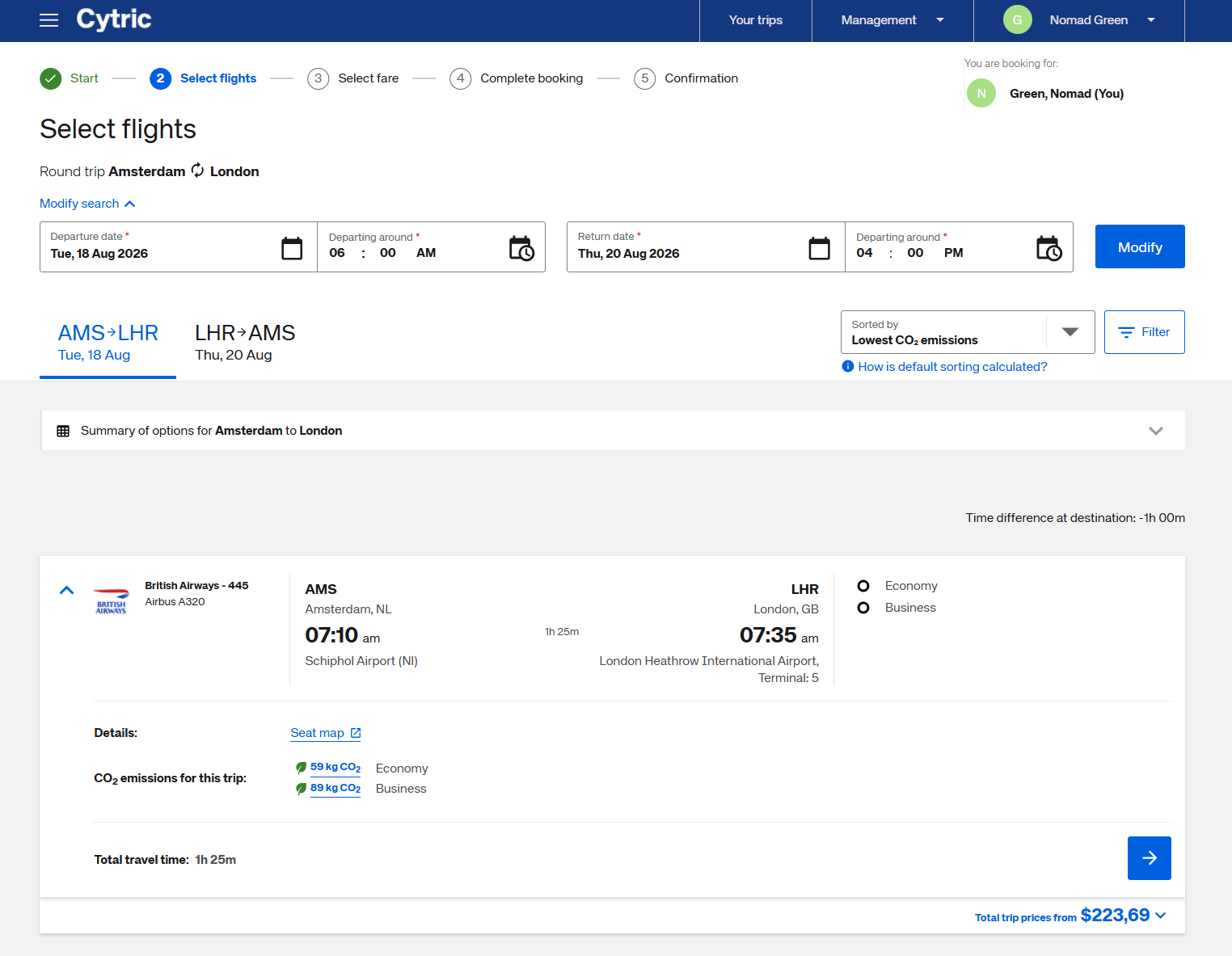
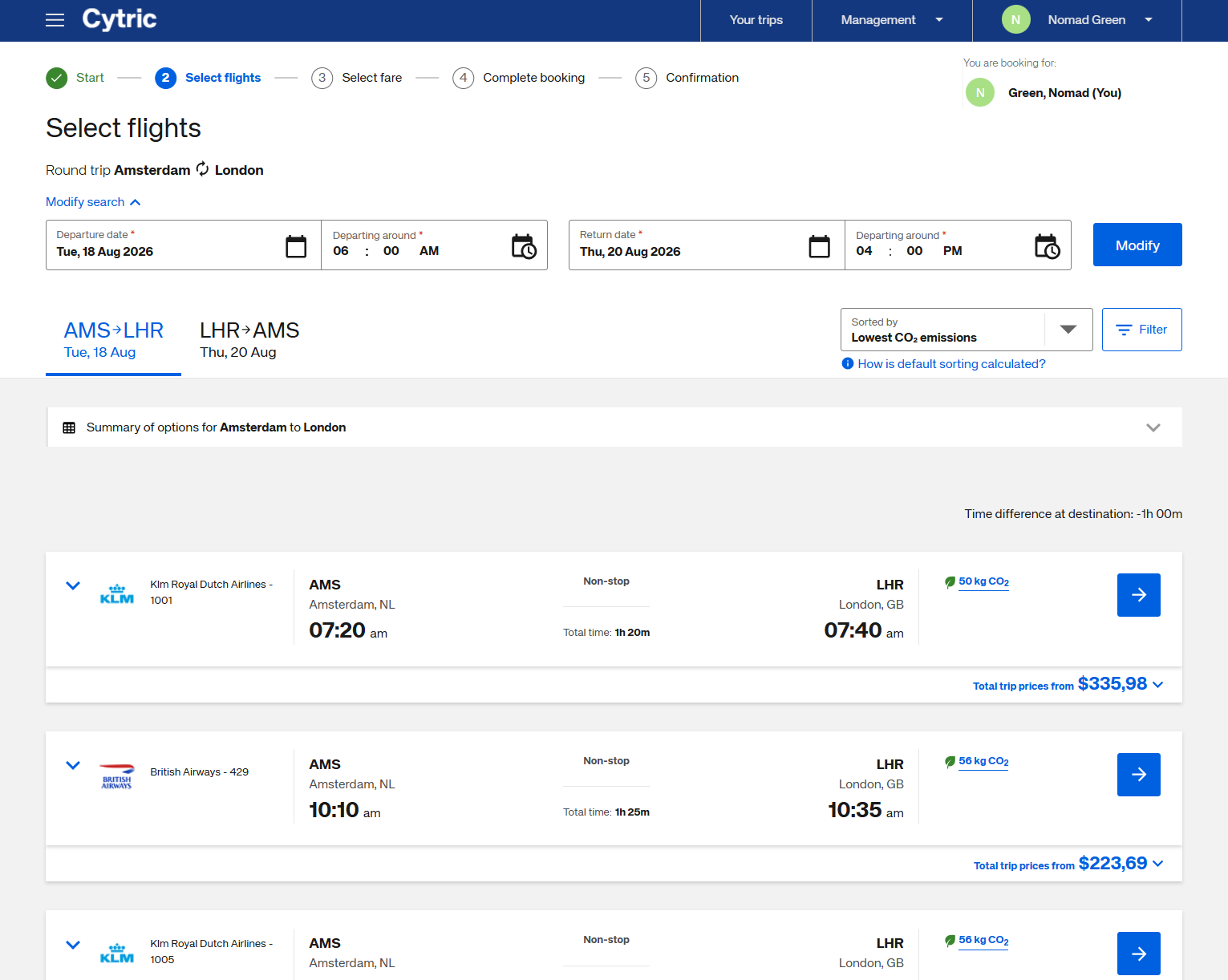
IATA CO2 Connect data is integrated in Amadeus core products like Master Pricer and Flex Pricer (shopping APIs), Selling Platform Connect (front-end for Travel Sellers), Cytric (self-booking tool for TMCs & Corporations), Dynamic Travel Documents and in many other areas/products, with the last part of the integration roadmap to be completed in the coming months.
The following is the full list of Amadeus products planned to integrate IATA CO2 Connect:
This integration enables emissions data to be displayed directly within search results, journey bookings, and corporate travel management solutions.
For airlines and travel agents already using Amadeus that wish to access IATA CO2 Connect data and request access to it, this means for the Amadeus Products already integrated, a rapid activation with minimal disruption, leveraging existing workflows rather than introducing new ones.
As the ecosystem evolves, additional availability, including through Navitaire, is expected to further expand access.
Contact Amadeus for more information.
Example: Reference Experience
|
Example: Cytric (AMS-LHR) detail |
Example: Cytric (AMS-LHR) list |
Through its partnership with IATA, Chooose integrates IATA CO2 Connect data into customer-facing experiences.
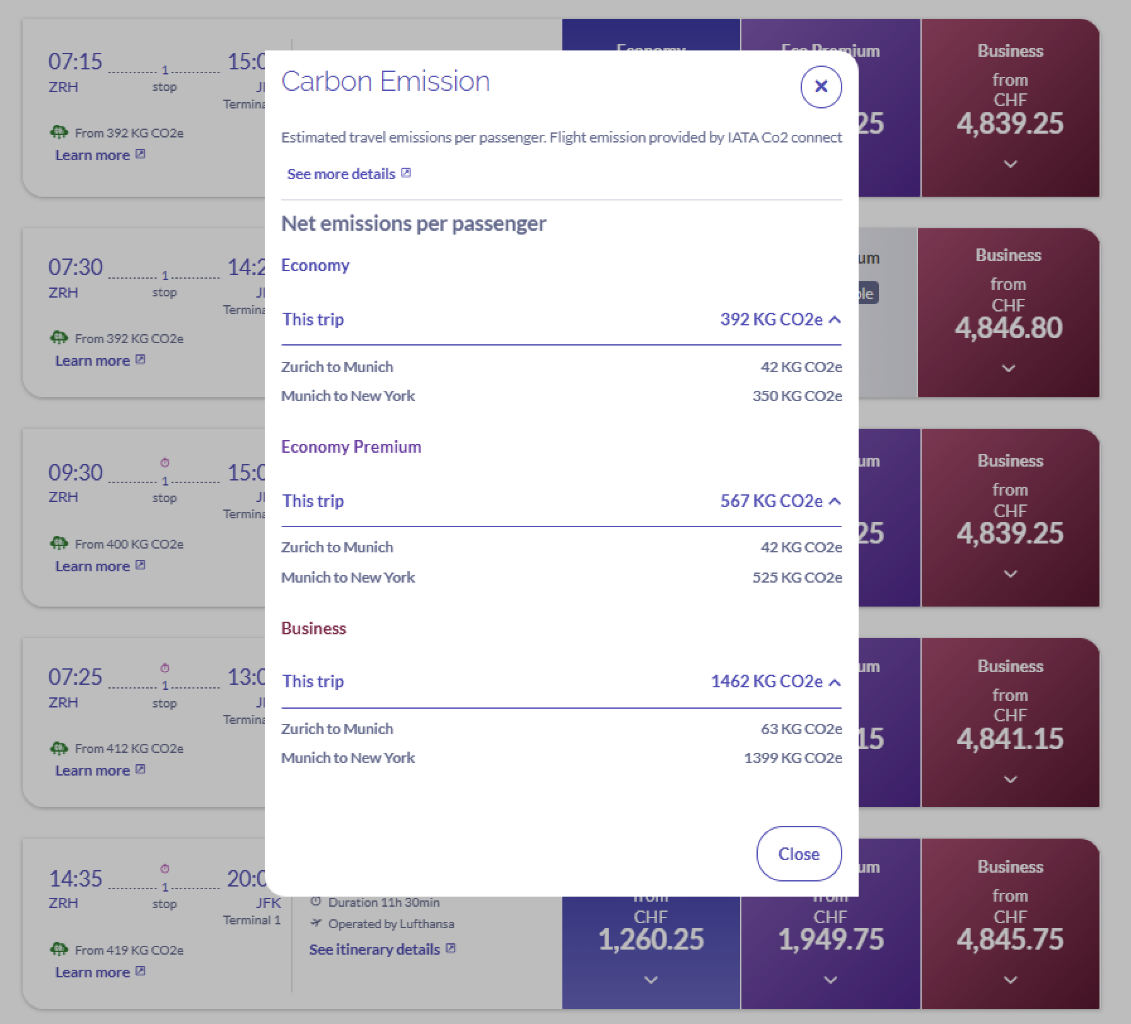
The process is straightforward. IATA calculates CO₂ emissions based on operational airline data, which are then integrated into Chooose solutions. From there, emissions information is delivered directly to airline consumer and corporate customers through booking flows, web applications, and business portals. At the same time, Chooose enables airlines to present this information in a clear, engaging format helping customers understand their emissions impact.
Live examples can be seen in the following airlines, where emissions data is integrated directly into a Chooose web application.
Contact Chooose for more information.
IATA CO2 Connect is also available via ATPCO, the backbone of airline flight pricing distribution.
Through the Routehappy API, airlines and channels can elect to within flight shopping displays and retailing environments.
This broad reach ensures that emissions information is not confined to a single channel but can be consistently displayed across pricing, shopping, and distribution workflows, supporting industry-wide comparability.
Contact ATPCO for more information.
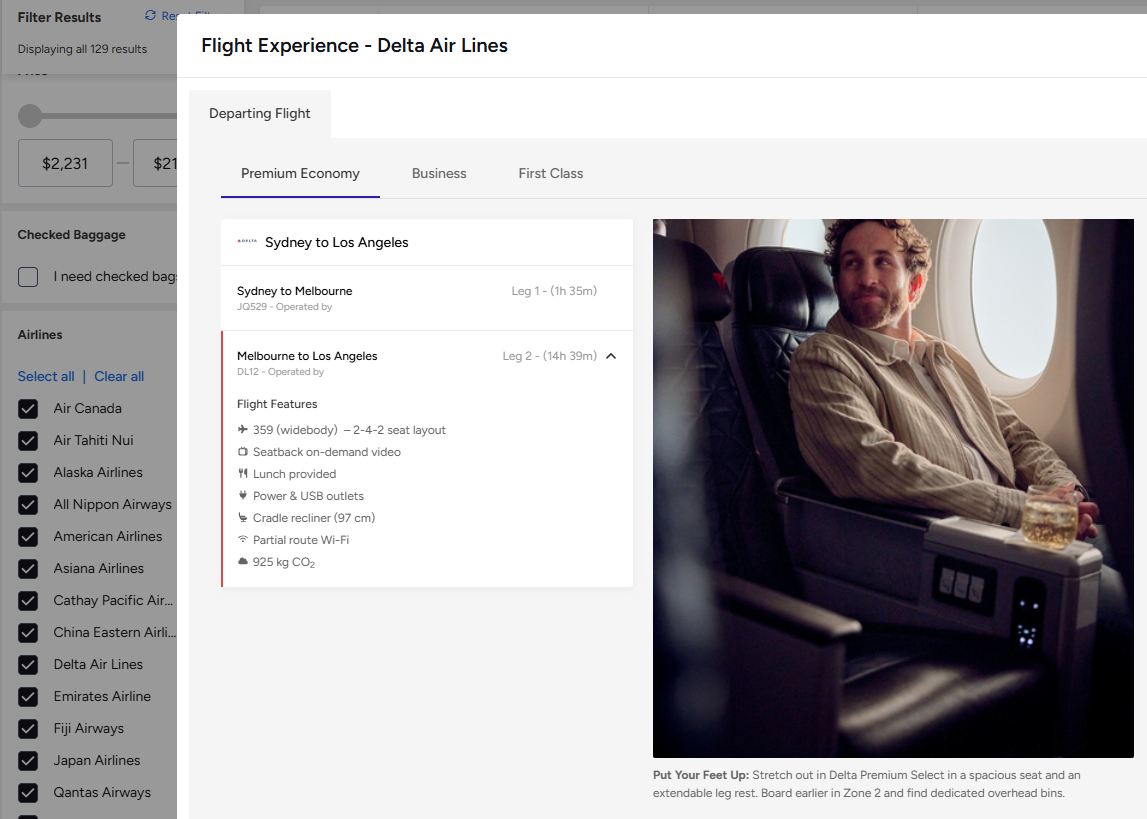
Example: Routehappy API (MEL-LAX)
Preparing to comply with the Swiss CO2 Act from January 2027 is not necessarily easy for the travel value chain, with a range of dependencies and priorities to consider. Nevertheless, the building blocks are already in place: across systems, data, and partnerships.
To learn how to activate IATA CO2 Connect and ensure compliance with the Swiss CO₂ Act.

From January 2027, organizations offering flights departing from/arriving to Switzerland must provide passengers with transparent information about the estimated CO₂ emissions associated with their journey. This requirement applies across the travel value chain, including airlines, travel agencies, tour operators, and other organizations selling eligible flight itineraries.
The regulation applies to airlines, travel sellers, travel agencies, online booking platforms, and tour operators offering journeys that include flights departing from/arriving to Switzerland. Airlines are also required to make relevant emissions data available to their commercial partners that sell their flights.
The obligation to display flight emissions information becomes effective on 1 January 2027 for applicable flight offers.
Flight providers must clearly display estimated emissions per passenger in CO₂ equivalents (CO₂e). The information must be visible and easily understandable as part of the flight offer, enabling travelers to make more informed decisions.

Yes. If a package holiday includes a flight departing from/arriving to Switzerland, emissions information for the journey must be disclosed as part of the offer.
Airlines can distribute emissions data through industry solutions such as IATA CO2 Connect. Data can be accessed directly through APIs and flat files or through integrations with travel technology providers and distribution systems.
IATA CO2 Connect is an industry solution that provides standardized per-passenger CO₂ emissions calculations based on actual airline operational data. It helps airlines and travel sellers access consistent, comparable emissions information for customer communications and regulatory reporting requirements.
Unlike models that rely on industry averages, IATA CO2 Connect uses real airline operational data, including aircraft type, fuel burn, load factors, and cabin configuration. This enables more accurate and representative emissions calculations for individual flights.
Yes. IATA CO2 Connect is the first industry emissions calculator to incorporate Sustainable Aviation Fuel (SAF) accounting, helping reflect the evolving environmental performance of air travel.
Travel sellers can access IATA CO2 Connect data directly or through integrated partners such as Amadeus, Chooose, and ATPCO. These integrations allow emissions information to be displayed within booking flows, flight search results, corporate travel tools, and retailing platforms.
IATA CO2 Connect provides standardized emissions calculations and distribution capabilities that can help airlines and travel sellers meet emissions disclosure requirements while ensuring consistency across customer touchpoints.
Standardized emissions data improves transparency, comparability, and trust for travelers. It also helps airlines, travel sellers, and technology providers use a common methodology, reducing inconsistencies created by multiple calculation approaches.