Gain practical insights into document control systems with Scott MacKenzie, Head of IOSA Program at IATA, drawing on his extensive experience supporting airlines in meeting IOSA standards and strengthening operational safety.
A document control system (DCS) has become an integral component in aviation safety and efficiency.
Even a small airline will have numerous operational, regulatory, and safety documents to manage. For a large and global network carrier that management responsibility becomes vastly more complex.
A fit-for-purpose DCS is indispensable for aviation organizations, facilitating compliance with industry standards, enhancing operational consistency, and ensuring the accuracy of essential procedures. Through properly managed documentation, airlines can mitigate risks related to obsolete or inaccurate information, optimize workflow efficiency, and promote accountability across all departments.
“Think of it from a safety audit point of view. Airlines might have dozens of manuals and several hundred to several thousand people involved in various processes. A well-managed DCS keeps everything up to date and aligned. It would be very easy for issues to arise if that wasn’t the case.”
- Scott MacKenzie, Head of IOSA Program, IATA
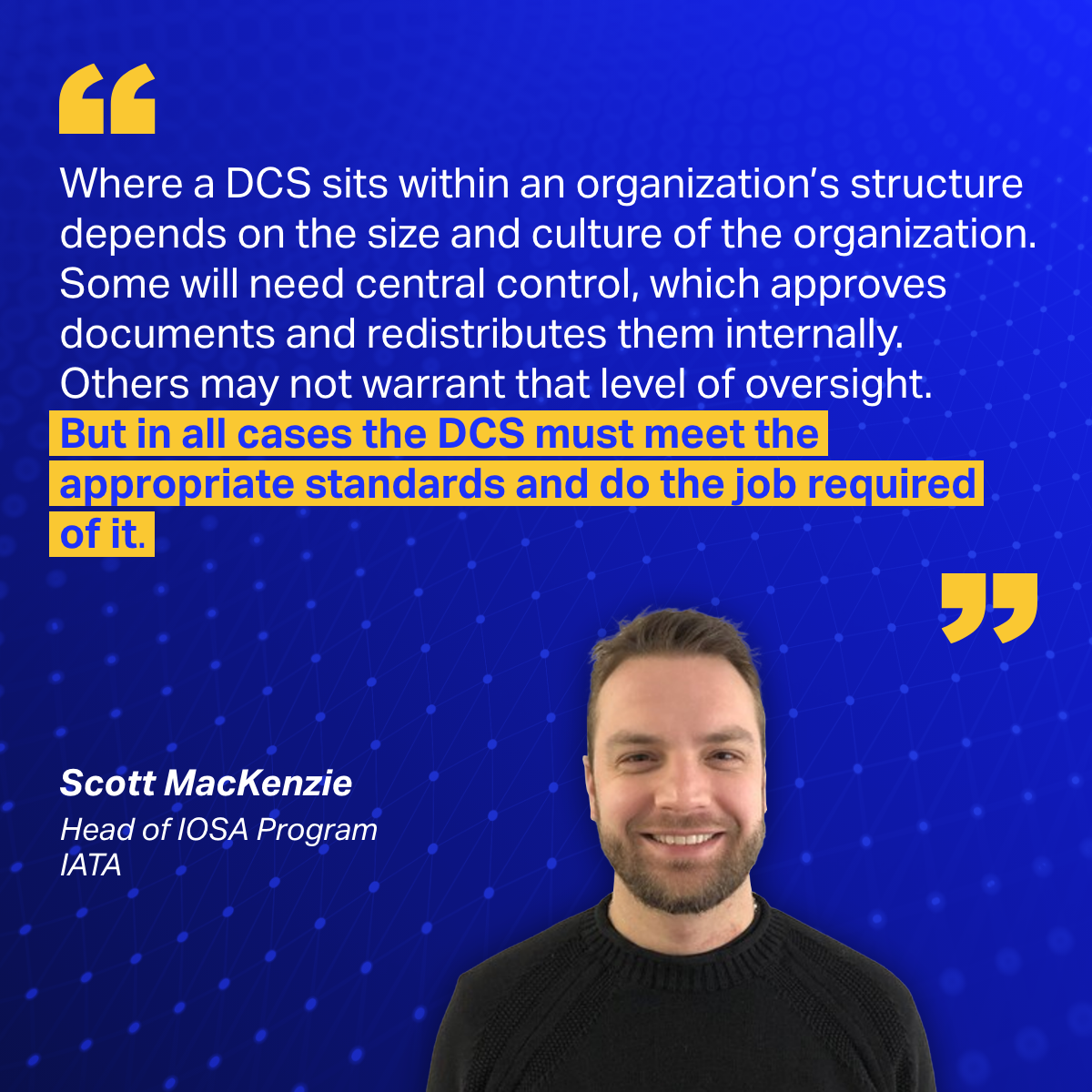
A good DCS will vary according to the size and circumstances of the organization. Accordingly, there are multiple ways to approach the topic.
A strong DCS is not necessarily a high-tech affair, with software and artificial intelligence (AI) sorting through thousands of pages. Even printing manuals and periodically replacing those pages that have changes is a system. It may be time-consuming and hard on resources but if it is done correctly the only difference is the execution.
There are common denominators, however. A robust DCS framework will have
These elements form the basis of training on the subject.
For a DCS to be successful, the multiple challenges and opportunities in accessibility must be correctly handled.
First, everybody in the organization must be reminded of the importance of using manuals, which requires training and education. If an organization has the correct culture, the right questions are asked, and this ensures that manuals are used as intended. Some systems will require a user to log in and review documents regularly.
But this is a nuanced area. Many airlines are developing Apps to enable access to manuals on the job. But this must be thought through for ease of use. Can an employee do their job if one hand is holding a smartphone or iPad, for example? Moreover, a screenshot of a page in a manual is only good for a short period of time. Screenshots can’t be updated and so relevance could be an issue.
There are many other considerations. First, access must be available 24/7. The need to reference documents doesn’t necessarily occur Monday to Friday during office hours. This does not mean being loose with access permissions, however. Employees need to be focused on their position and shouldn’t have to contend with information overload. Thought must also be given to external parties that may need access. This must be done while maintaining appropriate security.
A compliant DCS is a challenge for a large number of operators and is a frequent finding in IOSA. Audit focus areas include:
Common non-conformities include outdated or obsolete documents in circulation, inconsistent formatting or terminology, and limited accessibility or poor document organisation.
Distribution to external service providers is also a difficult area as security must be balanced with accessibility. Third parties may not be granted permission to use an organization’s intranet but, at the same time, there needs to be a mechanism in place to ensure third parties are correctly—and regularly—using relevant manuals.
Alignment is another challenge. It must be emphasized that no department is independent and all changes must be properly broadcast to ensure that everybody affected has an opportunity to input. Internal reviews and audits must maintain the DCS, taking into account the resources of an organization.
AI will streamline document control by automating tasks, improving search and retrieval, and strengthening quality assurance, leading to greater efficiency and accuracy.
But though AI will assist in catching inconsistencies in terminologies and definitions, it can’t implement a strong DCS process. An effective system is still at the heart of a robust DCS and AI will need to build on that platform.
“It is about being fit-for-purpose. What is it that AI can do that your people are struggling to do? AI will doubtless play a role, but it is a tool for people to use. And like all powerful tools it should be used with caution.”
- Scott MacKenzie, Head of IOSA Program, IATA
Four steps can immediately transform a DCS:
A DCS sits at the heart of safe, efficient aviation operations. All the information needed to adhere to regulations, best practices, and quality management is contained within numerous manuals and subjecting these manuals to some form of control is therefore essential. What that control looks like depends on the organization, but it is central to success in air transport.
IATA offers a comprehensive safety training curriculum that helps aviation professionals strengthen operational safety, regulatory compliance, and quality management. Spanning areas such as IOSA, safety management, human factors, and auditing, IATA training combines global standards with practical application. Within this portfolio, the Document Control Systems course provides hands-on guidance on establishing and maintaining effective document control practices to keep critical manuals current, accessible, and aligned.