
What really shapes an airline’s success? Koen Karsbergen, IATA External Instructor, and Davit Mamulaishvili, IATA Senior Product Manager, Airline Business Management and Travel Tourism Training, explore why Network Planning sits at the heart of airline strategy—and how it influences everything from fleet decisions and partnerships to resilience, sustainability, and long-term profitability.
Airlines fly people and goods from A to B. This simple proposition is at the heart of the aviation business and the foundation for every other product or service. If an airline doesn’t fly where the passenger wants to go or shipment needs to go, it won’t secure a booking.
This makes Network Planning central to every aspect of airline strategy. Network Planning takes the business model of an airline—from low-cost to regional point-to-point to network carrier—and translates that into a network of marketable city pairs.
“In its purest form, Network Planning serves as the brain function of an airline, influencing what other departments should do, when and where," says Davit Mamulaishvili, IATA’s Senior Lead, Airline Commercial and Financial Management.
Fleet management is perhaps the obvious area affected by Network Planning. Network decisions directly impact what type of aircraft needs to be selected and acquired to execute network plans.
Consider, for example, the exact make-up of the business and leisure segments of a potential market. A business traveler wants frequency, which suggests a smaller aircraft flying more often. A leisure passenger is price sensitive, however, and so less sensitive to scheduling and a larger aircraft might be applicable, as that offers reduced unit cost.
But this is just the tip of the iceberg. From pilot and crew recruitment and scheduling to operations to marketing to catering, every decision made by a Network Planner ripples through an airline’s organization. And it all stems from where the customer wants to fly, and the price they are willing to pay.
“Most successful airlines globally have network professionals who can understand not only what decisions to make, but why those decisions matter to the overall strategy," says Mamulaishvili.
Network Planning is a double-edged sword. The decisions made touch on every aspect of the aviation ecosystem, but the ecosystem’s impact on the initial decision is similarly diverse.
Aside from the obvious financial implications—will a route be profitable or at least contribute to overall profitability—factors that a Network Planner should consider, include forecasted demand, market conditions, costs, and capacity.
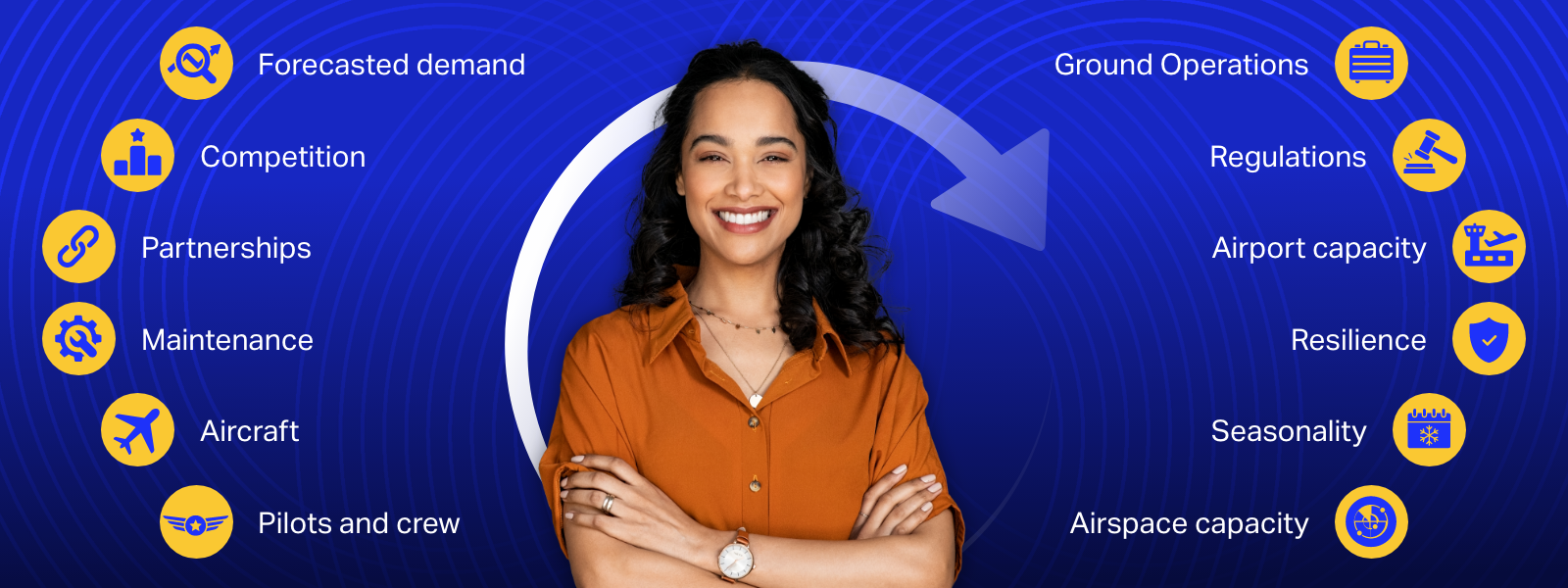
It is important to understand forecast limitations and work with scenarios to prepare for best and worse case realities. But an airline always needs to be sure there is sufficient passenger or cargo demand. Although data and the tools to analyze that data are becoming more plentiful, so too is market volatility.Geopolitics, economic downturns, or a pandemic are among the many elements that can rapidly render the best forecast null and void.

What competitors or partners do can also make a significant difference. The rise of low-cost carriers has significantly changed how network carriers go about their network planning on short-haul feeder routes, for example. Network Planning for smaller carriers, meanwhile, is greatly influenced by their associations and partnerships with other airlines and airline alliances. How such dynamics play out can make or break a route’s profitability
Amid all these nuances, it is critical that the Network Planner is fully aware of the airline’s resource limitations. What strains would a new route put on maintenance schedules, ground operations, and crew scheduling to name but a few? Can pilots be recruited and how long would it take to train them? Can pilots be recruited and how long would it take to trainthem? Can the airline source and acquire an aircraft given the lengthy delays being seen in the supply chain?
And just deciding that a route would complement the network doesn’t make it so. There are a number of potential hurdles to overcome. Across borders, there are sometimes limits on the number of flights between two countries. Indeed, a myriad of national and international regulations must be factored into the equation, including safety standards, flight time limitations for crew duty time, environmental emissions rules, and bilateral air service agreements.
Even assuming a flight is possible from a regulatory point of view, the capacity of the destination airport might not allow it. The number of slot-constrained airports is growing, especially among key hubs, and airlines are adding seats faster than airports are adding capacity. Simply, there may not be a slot available for a flight.
There is also seasonality in travel demand, adding another layer of complexity to Network Planning and the need to find counter-seasonal opportunities. Resilience, too, is becoming increasingly important. Weather events are becoming more common, for example. Would a new route raise the risk of disruption, which could spread throughout the network?
Such a diverse skillset requires the best possible training, Mamulaishvili insists. “We can give airline network planners the most advanced forecasting and data tools in the world, but without proper training and knowledge, they’re just dashboards without any vision or direction," he says.
Training to become a Network Planner takes a logical flow, starting with an examination of airline business models before moving on to Network Planning and the complexities involved.
“We emphasize that no department can act on its own,” says Koen Karsberg, IATA External Instructor. “Every decision affects every other department and that is the key takeaway from training. It means Network Planners must collaborate andspeak& the same language as colleagues. There can't be different terminologies or different definitions.”

Training also stresses that finding the most profitable solution for an airline can mean sub-optimal solutions for each department. Maintenance is a case in point. The optimal solution is one aircraft type maintained during regular hours to keep costs down. But Network Planners must consider different aircraft types, unscheduled engineering requirements, and the skillsets and shift work needed to ensure excellent aircraft availability.
“People assume Network Planning is a combination of the most profitable routes,” says Karsbergen. “But sometimes you can have an unprofitable route that nevertheless contributes to the profitability of other routes and the overall profitability of an airline. “Everything has to be considered and that’s why Network Planning is so interesting, so varied, and such a great career opportunity.”
Network Planning continues to adapt to aviation’s evolution. The need for good data, such as IATA’s Direct Data Solutions, is increasingly critical. Only detailed data can help a Network Planner to understand trends, traffic flows, and competition.
Usually, Network Planners will look at historical data. Going back about five years is the norm but the pandemic has effectively created a two-to-three-year hole. So, in a sense, Network Planners are currently flying blind. Karsbergen says this illustrates both the vital role of data and the potential for new talent to make a notable impact
Artificial intelligence (AI) will play a key role in analyzing the data and future Network Planners’ skillset will need to incorporate working with AI. In the future, network planning will be more and more powered by smarter data and digital tools, but Mamulaishvili says it “will always require human judgment to recognize opportunities and capitalize on them.” Network Planners will remain fundamental to the airline business.
Other emerging trends include the industry’s customer personalization centricity efforts, known as Modern Airline Retailing. Basically, the better airlines know their customer, the better the network, schedule, and fleet they can offer.
Sustainability is a growing influence too. Airlines are looking to minimize emissions and there are also various regulations either in force or coming into force, such as European Union Sustainable Aviation Fuel (SAF) mandates and the Carbon Offsetting Reduction Scheme for International Aviation (CORSIA). Network Planners must therefore consider SAF availability, applicable emissions trading schemes, and whether airport charges consider lower emission aircraft.
Network Planning is truly a big picture career. A Network Planner must be not only a master of the trade but a jack of all other trades too.
It’s crucial to develop a skillset that takes those decisions to the next level. As Mamulaishvili puts it: "The very best network planners don’t just chase demand, but they also tend to create it by connecting city pairs that might not have been efficiently linked before.”
Taking passengers and goods from A to B may not be such a simple proposition after all.
“The most important skill for a network planner is the love of coffee. You need to talk to everyone and understand at least a little bit of everything from ground ops to maintenance to crew scheduling—because they are all influences on your decisions.”- Koen Karsbergen, IATA External Instructor
IATA Training offers a comprehensive Airline Management curriculum designed to build strategic and commercial expertise across all levels. Beyond network planning, our courses cover revenue management, marketing, finance, and data-driven decision-making. The Network Development and Management Diploma provides focused qualification that equips professionals to make data‑driven network decisions and contribute directly to an airline’s commercial performance. Whether you're strengthening core skills or preparing for executive responsibilities, IATA’s training supports your career growth with globally recognized certifications and industry-relevant content.
[1] https://airlines.iata.org/2025/11/09/punching-above-our-weight
[2] https://www.bbc.co.uk/news/uk-england-52323416
[3] https://www.eurocontrol.int/sites/default/files/article/attachments/201004-ash-impact-on-traffic.pdf