
What are the consequences of a troubled aviation supply chain for airlines? Enda Corneille and Koen Karsbergen, Aviation Consultants and IATA Certified Instructors and Course Developers, and Davit Mamulaishvili, IATA Senior Lead, Airline Commercial and Financial Management Training, explore the challenges facing airlines and the difficult business decisions that need to be made.
Despite the challenging geopolitical conditions, most airlines continue to register strong passenger demand across all cabins. Compared with previous periods, market conditions were relatively begin in 2025 as evidenced by the 5.3% growth.
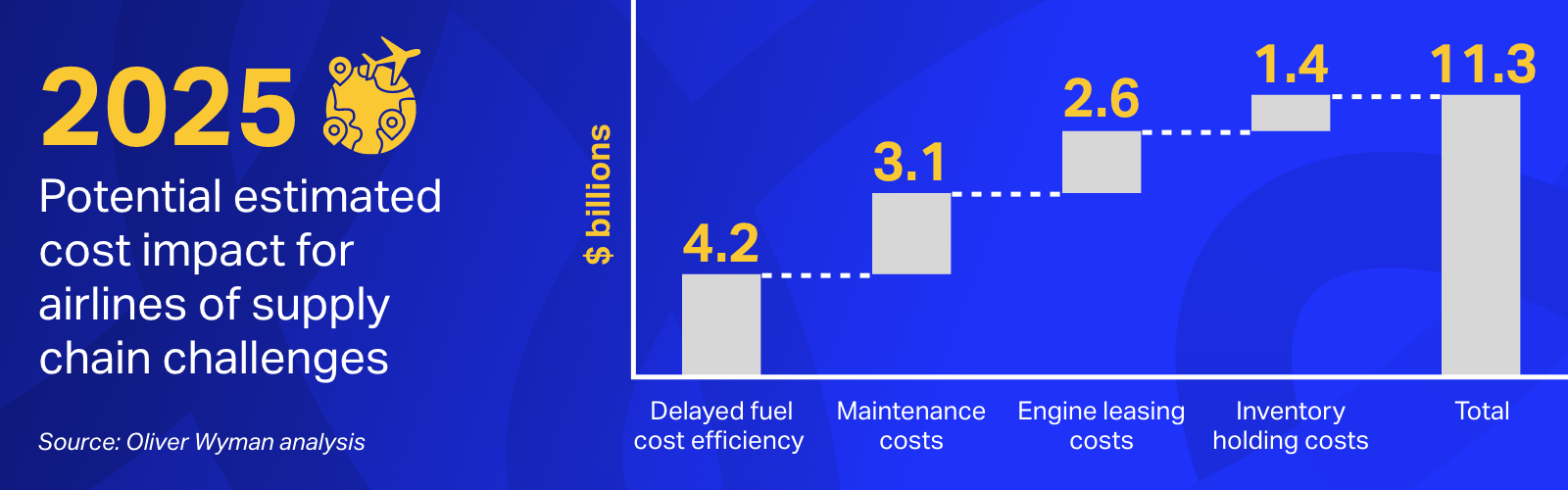
But the 3.9% profit margin this growth enabled is still razor thin and easily wiped out by a shock or escalating challenge. The $39.5 billion net profit in 2025, for example, can be seen in the context of the additional $11 billion in costs incurred by supply chain issues.
Managing these issues is therefore of paramount importance. But it won’t be easy. Even if the supply chain is working well, buying an aircraft is complex. Airlines must acquire a fuselage, engines, avionics, seats, lighting, and much more. There is no “ready to go” package akin to purchasing a new car. And when each of these steps are constrained, problems begin to mount.
This is not a single stakeholder issue. All parties in the aviation supply chain are suffering because of the mutual reliance that exists.
1. The MRO aftermarket must be opened up
Because older aircraft being kept in service longer, there is an increasing requirement for parts. Unfortunately, the parts market is hampered, with OEMs dominating due to aftermarket contracts.
Technology is bolstering this situation. New propulsion systems, advanced coatings, composites and the like use processes that are more difficult to reverse engineer and substantiate equivalency, providing original design holders with an advantage.
Suppliers have, moreover, merged to gain scale and bargaining power with airframers, reducing overall supplier numbers and boosting their control of the aftermarket. This has made it harder for independent service providers to offer alternative aftermarket solutions, shrinking MRO options outside OEM-affiliated providers and often raising airlines' maintenance costs.
Adding to this, trade-related tariffs on metals and electronics have intensified supply bottlenecks and increased maintenance costs. Parts can cross borders multiple times as they are assembled, making a difficult situation even more complex.
Overall, the aviation supply chain remains fragile, relying on few suppliers, and facing risks from economic uncertainty, changing tariffs, and tight labor markets. There are, moreover, continued geopolitical risks, related airspace/border closures, and other negative externalities affecting the parts supply chain.
2. Aircraft production delays limit fleet renewal plans
The lack of available aircraft is becoming acute. If an airline orders a new aircraft today, they will probably wait four or five years before receiving it. For long-haul aircraft, that timeline might even be extended.
Compounding this difficulty are certification delays. The Boeing 777X and the MAX7 / MAX10 are cases in point. Delivery can’t begin until an aircraft is certified.
All things considered, it is estimated that it will be 2031 at the earliest before the supply chain normalizes the structural mismatch between airline requirements and production capacity.
Meanwhile, uneven impact among airlines limits opportunities and creates disparity.
3. Engine manufacturing and MRO delays are increasing costs
A lack of new aircraft may be the headline, but it is engine issues that are causing both upstream and downstream challenges.
Engine production has fallen behind airframe output due to technical problems and a lack of skilled workers. Both manufacturing and repairs are slow because production errors must be fixed and the current MRO capacity cannot handle these extra corrections alongside routine maintenance.
For airlines, this is a double whammy. Some new engines have proven to be faulty forcing airlines to ground their aircraft until the faults are mitigated. And older engines require longer maintenance, repair and overhaul (MRO) shop visits. Either way, the result is costly, not only in financial terms but also for sustainability. Fuel efficiency effectively stagnated in 2025 for the first time since measures began.
Potentially, airlines could insource some maintenance-related activities, but in most cases, balance sheets are not yet strong enough to support the initial investment given the volatile market conditions.
4. Workforce shortages across the aviation supply chain
In general, the industry is dealing with a workforce squeeze that has been seen across aviation post-COVID. But engineers and technology specialists are especially in demand. Aviation must compete with other industries for their talent, which is challenging for an industry not known for high salaries. And training to the high safety standards required by industry means onboarding can be far longer than in other sectors.
Retirement is also taking its toll. The loss of talent during the pandemic continues as a generation of skilled workers wind down their careers. By 2034, aviation will need to hire as many people as are already employed in the industry.
“If you cut down on the number of engineers working on parts, cut down on the number of people doing quality assurance, you end up in a spiral. Quality issues create distrust, distrust creates more regulations, and that slows down production.”
- Davit Mamulaishvili, IATA Senior Lead, Airline Commercial and Financial Management Training
The figures tell the story:
How much are aviation supply chain disruptions costing airlines?
An IATA report in collaboration with Oliver Wyman, addressed the supply chain challenges and found that it cost the industry more than $11 billion in 2025. The figure is broken down as follows:
The entire market is being skewed by these costs. The market value of two full-life engines, for example, now represents approximately 80% of a new aircraft. Going back two decades, this would have been 20-30%. Within six years of purchase, two full-life engines are worth more off-wing than on-wing, exacerbating supply chain issues.
Leasing rates are soaring. The market lease rate for narrowbody mid-life Boeing 737NG and Airbus A320ceo aircraft remain incredibly robust, with monthly lease rates ranging from $230,000 to $250,000. For new aircraft, the rate is in the range of $400,000 per month.
For engines, lease rates for the PW1100G have more than doubled since 2019, while the Leap-1A and -1B engines have increased more than 50%.
Strangely, engines might be up to 104-110% of the value of leasing an aircraft with engines. The upshot is that it could make more economic sense to dismantle and sell or lease the constituent parts of an aircraft than it does to refurbish and sell or lease for operational use, thereby adding to supply chain constraints.
Normalizing the situation might be possible and there are both short-term and long-term solutions.
Short-term solutions
In the shorter term, keeping older aircraft in the fleet longer and more efficient network planning are crucial. This imposes discipline on airlines to avoid growth for growth's sake, prioritizing profitable routes, delaying marginal expansion, and focusing instead on yield and network contribution.
But remember, this is being forced on the airlines and the downsides are considerable. Capacity scarcity leads to higher operational and maintenance costs, and airlines might miss out on profitable growth opportunities.
Fleet renewal and network planning must therefore be managed carefully. Each new destination—together with the aircraft to be used on the route—must be chosen precisely.
Airlines are refurbishing aircraft and front-loading their need for parts as far as possible. The situation may also drive greater consolidation in the industry as airlines look to offer their customers more destinations through codeshares and other forms of partnership.
Greater collaboration is also tempering potential issues. An example is IATA's renewal of an agreement with engine manufacturer, CFM, a 50/50 partnership between GE Aerospace and Safran Aircraft Engines. This supports increased competition in the market for MRO services for engines manufactured by CFM.
Beneficiaries of the agreement include CFM’s airline customers, aircraft lessors, third-party MRO facilities, and parts manufacturers.
In practical terms, the agreement:
Long-term solutions
Longer term, better staffing and use of technology should help accelerate production of both aircraft and engines, eventually normalizing the situation.
But there also needs to be a structural change in the aftermarket so that airlines have greater flexibility within a constrained supply chain. In short, MRO must be less dependent on OEM-driven commercial licensing models. Opening up aftermarket best practices would encourage the rise of new, independent MRO programs.
Airlines can play their part by increasing their awareness of supplier-furnished equipment, which is third-party equipment selected and supplied by the OEM. OEM agreements with these suppliers are available to airlines and describe the support available.

At the same time, repair and parts capacity must be expanded to accelerate repair approvals, support alternative parts and Used Serviceable Material (USM) solutions, and adopt advanced manufacturing techniques to ease bottlenecks. OEMS could provide the impetus by updating terms wherever alternative repairs are commercially discouraged or restricted. Such moves would reduce the pressure on traditional parts suppliers.
Greater visibility across all supplier levels, to spot risks early and reduce bottlenecks and inefficiencies, would support such initiatives.
In all efforts to find solutions, data is critical. Understanding and having visibility on how parts are moving through the supply chain would bring greater efficiencies and so reduce downtime. Data is also crucial for predictive maintenance insights, enabling airlines to better plan MRO and even avoid some lengthier repair operations. Sharing data would also make joint planning possible. Having each segment of the supply chain come up with its own solution for future efficiency would only create more problems. Having just one cog in the system not working has consequences for the entire supply chain.
Airlines should not remain idle due to supply chain challenges. Instead, they need to equip their teams for these complexities and ensure well-trained staff are available to help the company navigate such obstacles.
| ROLE | Implication | Course |
|---|---|---|
| Financial Officer | Aviation professionals will need to know how to manage the complex financial sums caused by supply chain complexity. | Airline Financial Management |
| Network Planner | Determining which destinations to serve with an ageing, limited fleet can make or break an airline. | Network, Fleet, and Schedule Planning |
| Procurement/Asset Management | Amid supply chain constraints, what are your options when looking to buy a new aircraft? | Aircraft Acquisition and Financing |
| Airline Management | How do you run a profitable airline when you can't fly the latest aircraft? Making the correct decision at the correct time is critical. | Airline Business Models and Competitive Strategies |


