

Hélène Manzoni, IATA’s Senior Manager, Fuel Efficiency Solutions and Philippe Morin, Principal Engineer, Aircraft Performance and Flight Efficiency, Air Canada discuss the strategies that can help airlines discover the marginal efficiency gains that could make all the difference to financial and sustainability success.
Fuel efficiency is often linked to sustainability. Burning less fuel reduces emissions and helps move aviation closer to its goal of net-zero carbon emissions by 2050. But fuel efficiency also shapes—and is shaped by—many other aviation areas, from cost control and financial forecasting to regulatory compliance and air traffic management.
The myriad factors involved were discussed in detail in a recent webinar, How Airlines Continue to Improve Fuel Efficiency Performance.
In many regions, fuel represents about 25%–30% of total airline operating costs, with recent volatility adding several percentage points.
In November 2025, the average global jet fuel price was around $96 per barrel (Brent). By April 2026, it had doubled before easing to about $158 per barrel in May. Jet fuel, which accounts for roughly 3 million barrels a day of global seaborne trade, has been hit harder than diesel and gasoline, with available supply estimated to be down 20%–30%.
Prolonged supply and flow disruptions drove price spikes, which are harder to manage than high but stable prices. Combined with intense competition, this limits airlines’ ability to pass costs directly to passengers, making fuel efficiency both a structural profitability lever and a foundation for sustainability progress.
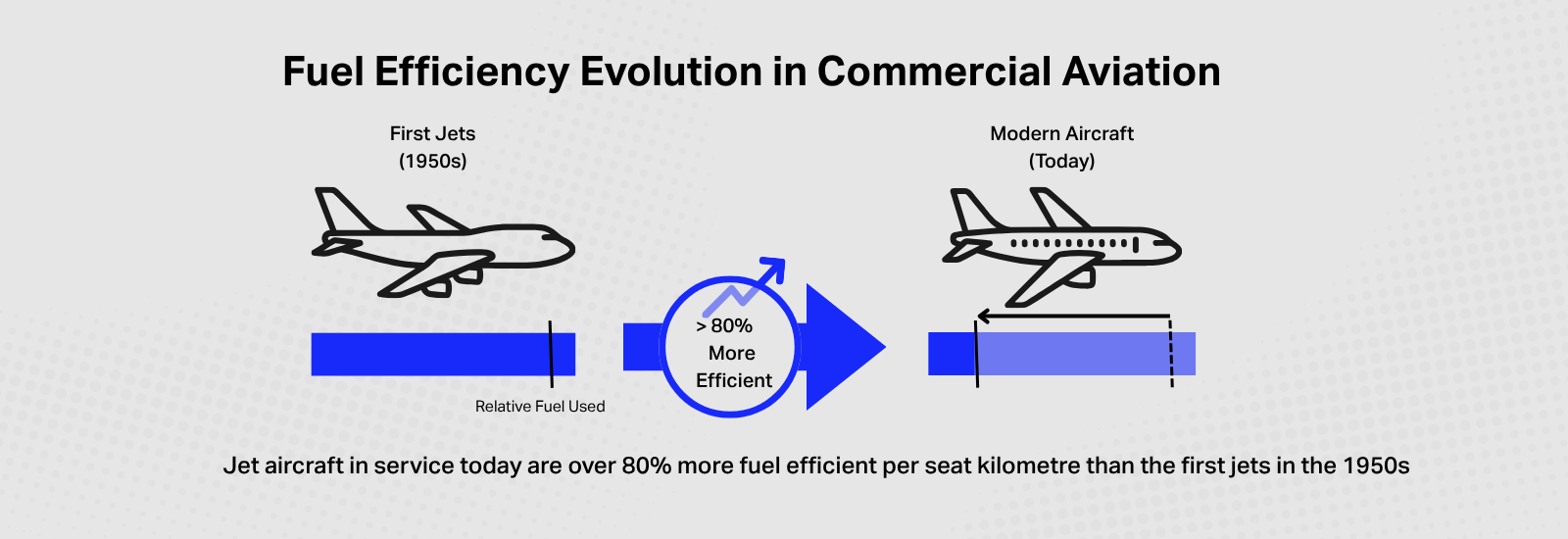
Because fuel is such a major cost, efficiency has long been central to airline operations. Modern aircraft are about 85% more efficient than those flown in the 1960s, and new-generation models are generally around 30% more efficient than older aircraft. Better fleet utilization has also helped. Before the pandemic, industry fuel efficiency improved about 2% a year on average.
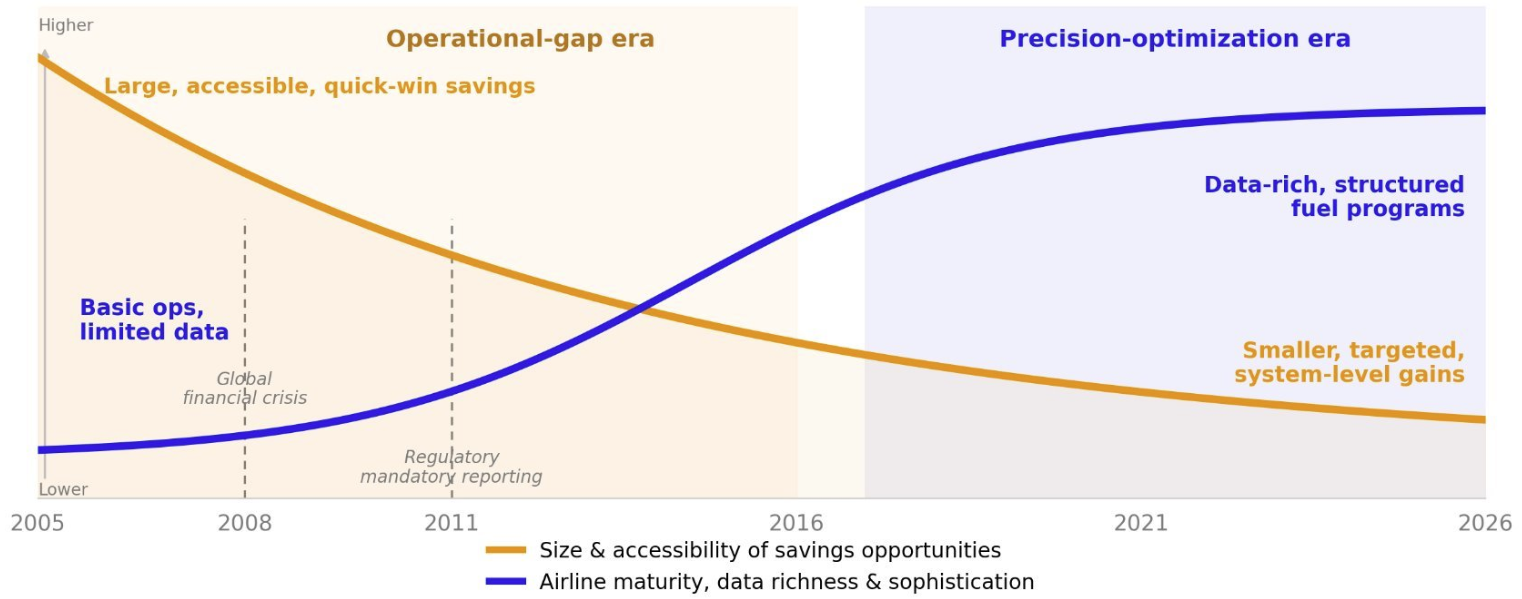
In the first two decades of the 21st century, lower maturity levels made improvements easier to identify. Airlines could often buy a solution, such as winglets, or make straightforward changes like removing paper from cabins and cockpits.
That has changed. As reporting obligations emerged, airlines needed better data and measurement capabilities. They also had to invest in maintaining existing gains, using data, automation, and training to keep initiatives effective. This pushed fuel efficiency into a more structured phase.
More recently, supply chain issues have forced airlines to keep older, less efficient aircraft in service, increasing the pressure to save fuel.
"Today, airlines operate in a more mature data-rich environment. Fuel programs are more structured, governance is stronger, and many of the obvious inefficiencies have been addressed. The remaining opportunities or more difficult to detect or more difficult to capture.”
Hélène Manzoni, IATA’s Senior Manager, Flight Operations Fuel Efficiency
Fuel efficiency depends on a complex mix of operational and technical factors, including:
Many obvious inefficiencies have already been addressed, leaving improvements that are more complex and harder to capture. Quick wins have given way to difficult trade-offs.
This complexity is rooted in how fuel efficiency gains are calculated. The process starts with theoretical savings—the gains possible under ideal conditions. A statistical model then accounts for operational constraints. Finally, there is realized efficiency, which often differs from modeled results for many reasons, including weather and human performance.
The gap between theory and reality can be significant. When potential gains are small even at the theoretical stage, it becomes clear why investment and prioritization decisions are so challenging. Even so, airlines must identify meaningful improvements that support both organizational and sustainability goals. That requires prioritizing opportunities, interpreting performance signals, and building confidence in decisions.
On-time performance illustrates the trade-off. Deciding whether a flight should speed up or slow down to stay on schedule affects fuel use, and airlines must balance efficiency with the timetable they have sold.

"The programs that the fuel working group are focusing on require more leg work to effect change and once they’re in place need more resources to keep at the same level of adoption. The resources cannot move away and go do the next thing.”
Philippe Morin, Principal Engineer, Aircraft Performance and Flight Efficiency, Air Canada
Several approaches can help airlines find meaningful answers. One method is to focus on manageable projects that deliver measurable efficiencies. In practice, this means prioritizing well and turning each opportunity into a business case.
Validation is widely used approach. Trials, testing, and proofs of concept show whether a theoretical gain delivers meaningful real-world results. Just as important, validation builds confidence and trust. Benchmarking results against peers can also reveal opportunities for improvement.
As maturity increases, airlines must also consider shifting from isolated projects to continuous improvement, with all stakeholders aligned. Financial, sustainability, and operational needs should be integrated into a system-wide approach. Ultimately, fuel efficiency becomes part of overall airline strategy, not a standalone project.
Artificial intelligence (AI) can transform fuel efficiency. It enables real-time route optimization based on changing weather, predicts when engines need servicing, and supports many other operational improvements. It can also analyze data to uncover trends and improvement opportunities.
AI can identify procedural inefficiencies, model improvement scenarios, and validate emissions reporting, for example. Together, these capabilities support smarter, more adaptive decisions that reduce fuel burn.
The most common benchmark is the industry’s average annual gain, which until recently was about 2%. But a fixed percentage reduction is not always the best target for an individual airline. Absolute targets can be difficult when an airline is growing quickly or changing its network or fleet. Improved regulatory compliance may also be significant even if it does not reduce an absolute figure. Instead of broad estimates or fixed targets, granular performance indicators may work better and help engage employees.


