
Reactive measures can offer short-term relief from rising costs, but structured fuel-efficiency programs build the long-term resilience airlines need to sustain financial performance during fuel-price volatility.
Rapid fuel-price shifts often prompt airlines to fast-track cost-control initiatives. Such situations highlight that, though immediate action is important, lasting efficiency gains require programs developed over time and underpinned by strong alignment and reliable data.
Fuel efficiency initiatives rarely deliver meaningful impact overnight. Measures such as optimizing flight planning, refining flight crew procedures, improving auxiliary power unit (APU) usage, or reducing aircraft weight require careful design, testing, and operational integration.
When fuel prices rise unexpectedly, airlines commonly revisit fuel-saving opportunities and accelerate selected initiatives. In these circumstances, a robust fuel-efficiency program can help provide direction, governance, and implementation discipline, reducing the risk that efforts become isolated or difficult to sustain. A coordinated program helps strengthen an airline's ability to respond to changing fuel-price conditions by embedding fuel efficiency into the airline’s long-term operational rhythm. It supports a more proactive and coordinated approach by ensuring that:
This is what resilience looks like in practice: the ability to adapt while maintaining operational stability and execution discipline.
Although most airlines already pursue individual fuel-saving initiatives, the maturity and structure of fuel efficiency programs can vary significantly across organizations.
Several recurring areas for improvement are commonly observed:
Governance and objectives Fuel efficiency is not always supported by a clearly articulated policy supported by strong executive sponsorship. In some organizations, targets are set through incremental adjustments rather than through a controlled process linked to operational levers and measurable outcomes.
Initiative management
Fuel-saving initiatives are frequently identified in an ad-hoc manner and prioritized based on feasibility to implement rather than potential impact. This often leads to a broad portfolio of initiatives being pursued simultaneously, making it difficult to maintain focus on the highest-value opportunities.
Data management and assurance
Data environments are sometimes fragmented across multiple systems or teams, creating challenges related to data quality, consistency, and coverage. There is no widely accepted single source of truth.
Promotion and engagement
Fuel policies and program results are not always communicated consistently across the organization, making operational engagement and cultural adoption more difficult.
These challenges rarely become visible during stable market conditions. But when fuel prices rise rapidly, the absence of a structured program becomes much more apparent.
A planned fuel efficiency program is only as strong as the data foundation supporting it.
Fuel efficiency improvements must be measured, validated, and monitored continuously.
Effective programs rely on three complementary layers of measurement:
When these layers are connected and supported by reliable data and peer benchmarking, airlines gain the visibility needed to set realistic targets, prioritize initiatives, and drive continuous improvement.
The industry’s evolving guidance—particularly the Fuel Efficiency Management Implementation Guide (FEMIG) and Fuel Efficiency Gap Analysis (FEGA) —reinforces the importance of structure, governance, and data.
These frameworks help airlines transition from isolated fuel-saving initiatives to a mature and repeatable fuel efficiency program.
Programs aligned with FEMIG and FEGA typically:
By providing clear guidance, these principles help airlines transform fragmented initiatives into a coordinated fuel efficiency strategy.
Resilient fuel efficiency programs are not built during a crisis—they are built long before volatility appears.
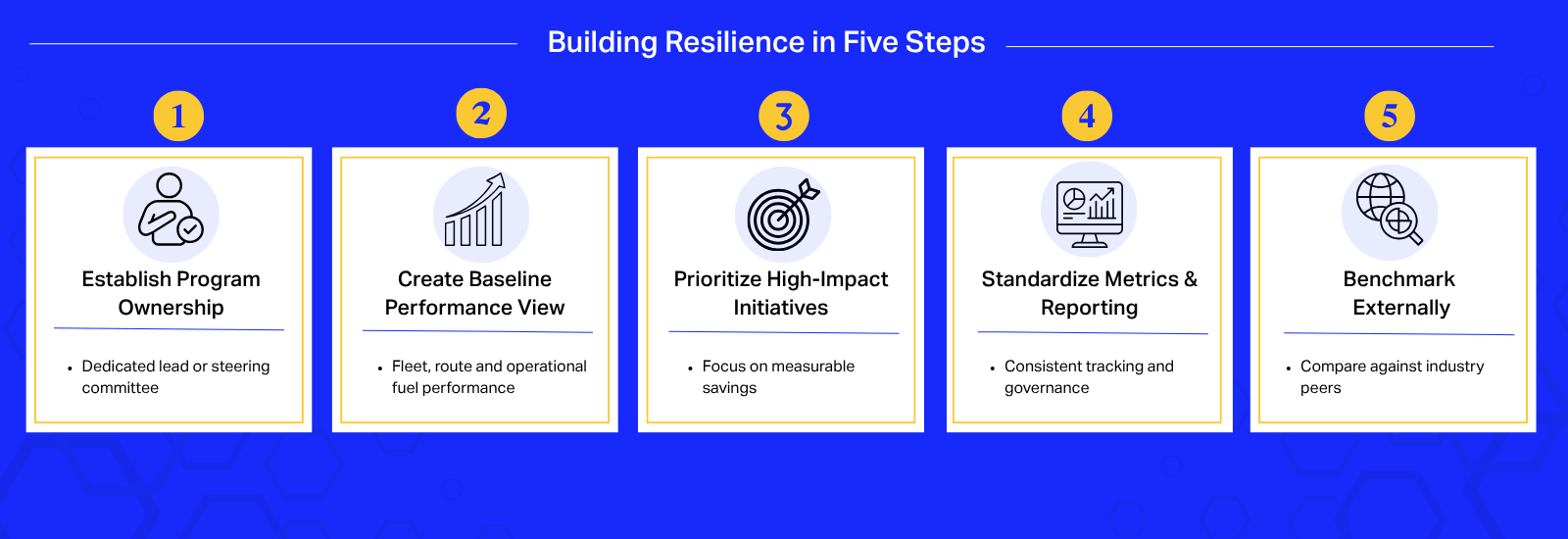
For airlines that have not yet established a formal program, five practical steps can help create the foundation:
These foundations allow airlines to move from reactive measures to a structured program capable of delivering sustained efficiency improvements.
Building a structured fuel efficiency program requires more than individual initiatives. It also requires the right frameworks, reliable data, and clear operational benchmarks.
IATA supports airlines with practical guidance and tools that help translate fuel efficiency ambitions into measurable operational improvements.
This support includes:
Together, these resources help airlines move beyond isolated fuel-saving initiatives and build structured, data-driven fuel efficiency programs capable of delivering sustained performance improvements—even in volatile fuel markets.


